Key takeaways
- Ganymede is the largest moon in the solar system, about 5,260 km across and wider than the planet Mercury
- Ganymede is the only moon known to have its own magnetic field, and it very probably has a salty ocean under its ice
- ESA's Juice spacecraft is due to enter orbit around Ganymede in December 2034
- From the UK, Ganymede is easy in binoculars as a dot beside Jupiter, which is in the morning sky now
Jump to section 7 sections
Ganymede: The Largest Moon in the Solar System
Ganymede is the largest moon in the solar system, an icy, rocky world about 5,260 km across that circles Jupiter. It is wider than the planet Mercury, it is the only moon known to make its own magnetic field, and it very probably hides a deep, salty ocean under its ice. ESA's Juice spacecraft is due to enter orbit around Ganymede in December 2034, which ESA says will make it the first spacecraft to orbit a moon in the outer solar system.
Ganymede orbits about 1.07 million km from Jupiter, nearly three times the distance from Earth to our own Moon. It goes round once every 7.155 days and always keeps the same face towards the planet. ESA calls it the largest and most massive moon in the solar system. It is the biggest of the four large Galilean moons, which Galileo Galilei discovered in 1610. The other three are Io, Europa and Callisto. Jupiter has 115 confirmed moons, as our guide to the newly found moons of Jupiter and Saturn explains, but the rest are mostly small and irregular.
Is Ganymede Bigger Than Mercury?
In width, yes. Ganymede is about 5,260 km across and Mercury about 4,880 km, so Ganymede is roughly 8% wider. NASA adds that it is bigger than the dwarf planet Pluto too, and it is about one and a half times the width of our Moon.
Mercury is far heavier, though. It is dense and full of iron, while Ganymede is mostly ice and rock, so Ganymede has only about 45% of Mercury's mass. It is still about twice as heavy as our Moon. Ganymede counts as a moon because it orbits a planet, however big it is. Saturn's moon Titan is the second largest, just behind it, and Jupiter's Callisto is third.
| Body | Diameter (km) | Mass (1021 kg) | Density (kg/m3) |
|---|---|---|---|
| Ganymede | 5,262 | 148.2 | 1,940 |
| Titan (Saturn) | 5,150 | 134.6 | 1,881 |
| Mercury | 4,879 | 330.2 | 5,427 |
| Our Moon | 3,475 | 73.5 | 3,340 |
| Pluto | 2,374 | 13.0 | 1,860 |
Does Ganymede Have an Ocean?
Very probably. NASA says there is strong evidence for an underground saltwater ocean on Ganymede that may hold more water than all of Earth's surface water. It might even be stacked in layers of ice and water, a bit like a club sandwich.
The best-known evidence came from the Hubble Space Telescope, which NASA announced on 12 March 2015. Ganymede's auroras, the glowing ribbons of gas around its poles, sway back and forth as Jupiter's own magnetic field changes. A salty ocean makes a second magnetic field that holds the swaying back, and Hubble saw the glow move by about 2 degrees instead of the roughly 6 degrees expected without an ocean. That team estimated an ocean about 100 km thick under an ice crust about 150 km thick. ESA now describes the ice shell as up to about 130 km thick, so the numbers are still being refined.
Nobody has measured the ocean directly, and no one has found life there. ESA does count Ganymede, Europa and Callisto as ocean-bearing moons worth studying as possible habitats. Saturn's Enceladus is another ocean world, though a much smaller one. A 2026 study in Geophysical Research Letters by Simon Cabanes, Thomas Gastine and Alexandre Fournier modelled how flowing ocean water could create magnetic signals of up to 9 nanotesla at the surface (a nanotesla is a unit for very weak magnetic fields). They concluded that Juice would need low orbits to detect it.
Does Ganymede Have a Magnetic Field?
Yes, and it is the only moon known to have one of its own. NASA's Galileo spacecraft found it in 1996. ESA says Ganymede is one of only three solid bodies in the solar system that make their own magnetic field. The other two are Earth and Mercury.
The field comes from a dynamo, which means liquid iron churning in a metal core. NASA says Ganymede has an iron core, a shell of rock around it and an icy shell around that. The field forms a bubble inside Jupiter's much larger magnetic field, and it creates the auroras at Ganymede's poles.
The field also leaves a mark on the surface. In 2023 the James Webb Space Telescope found hydrogen peroxide on Ganymede's ice, concentrated at the poles. Trumbo, Brown and colleagues reported in Science Advances on 21 July 2023 that the magnetic field funnels charged particles from Jupiter's surroundings to the poles, where they chemically alter the ice.
How the dynamo works is still an open question. In May 2026 a team led by Kevin Trinh, an Arizona State University graduate, suggested in Science Advances that Ganymede's metal core may still be forming today, and that the sinking of liquid iron towards the centre could stir the field. The team says this does not rule out an ordinary cooling dynamo, and that more work is needed.
What Does the Surface of Ganymede Look Like?
Ganymede has two kinds of ground. The dark areas are older and heavily cratered. The lighter areas are younger and have been pulled and split by tectonics, the movement of the ice crust. The brownish-grey colour comes from a mix of rock and ice, and the bright spots are recent craters and the debris thrown out of them. ESA describes it as a mix of the old, pockmarked ground you see on Callisto and the smoother resurfacing of Europa.
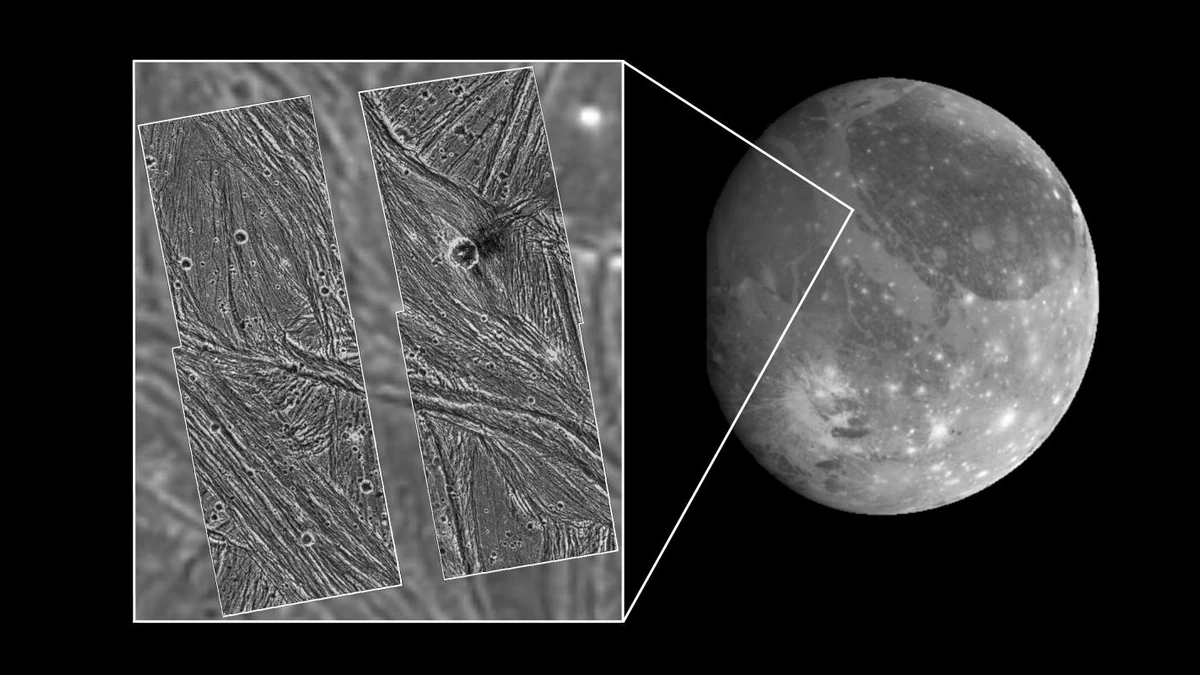
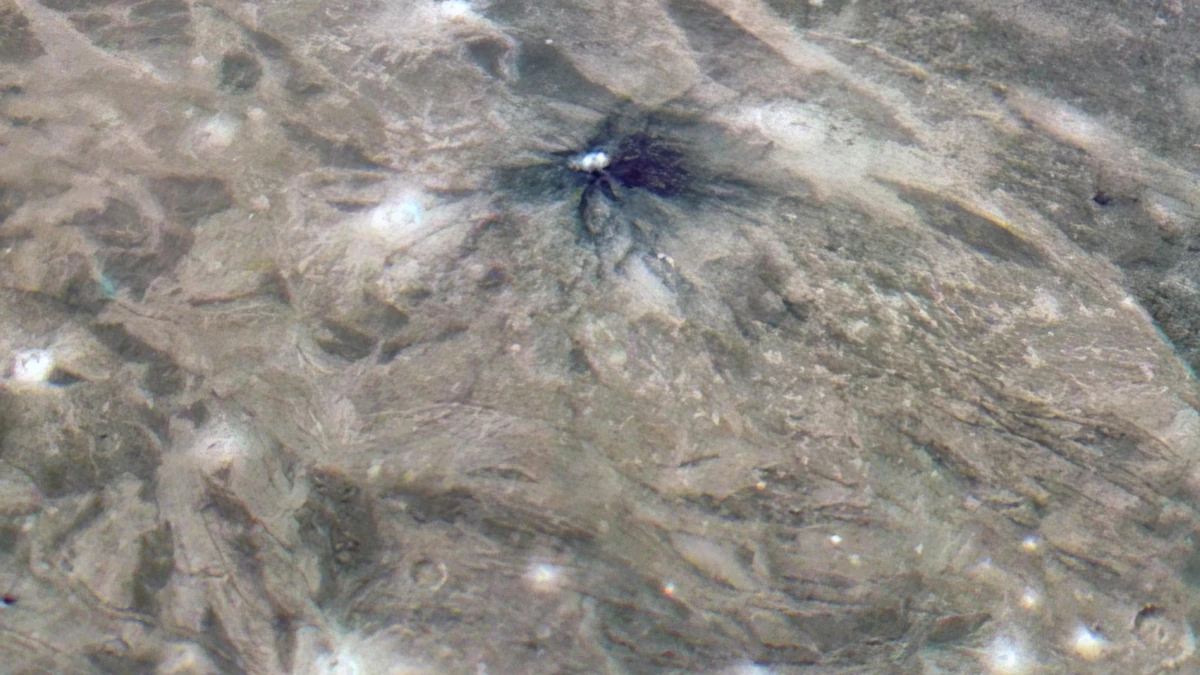
The lighter ground is carved into parallel ridges and troughs, which is what the close-up above shows. The craters tell their own story. Most of Ganymede's craters have bright rays of ejected material, but about 1% have dark rays. One of them, Kittu, is about 15 km across. NASA says scientists believe the dark rays come from contamination left by the object that hit the surface.
Ganymede is not a place for people. Its average temperature is about −160°C and its gravity is about one-seventh of Earth's. NASA says there is evidence for a tenuous oxygen atmosphere, far too thin to breathe.
Can You See Ganymede from the UK?
Yes, and it is one of the easiest moon sightings there is. Ganymede is about magnitude 5.5 now, brightening to about 4.8 by February 2027 as Jupiter moves closer to Earth. Smaller magnitude numbers are brighter, and Jupiter itself is about −1.9 now, rising to about −2.6 at its opposition on 11 February 2027.
The catch is Jupiter's glare. It is about 900 times brighter than Ganymede, and Ganymede never strays far from it. Its widest gap is about 4.3 arcminutes now (an arcminute is a sixtieth of a degree), growing to about 5.6 arcminutes by February. Through 10x binoculars that widest gap looks about 0.7 degrees across, wider than the full Moon looks to the naked eye. Between 5 October 2026 and 12 February 2027, Ganymede is more than 1 arcminute from Jupiter's centre about 87% of the time, so most nights it sits clear of the worst of the glare.
Jupiter is in Leo and in the morning sky. It rises at about 02:13 BST in Birmingham on the night of 5 to 6 October, and between 04:43 and 06:04 BST it is more than 20° up while the sky is still properly dark, while the Sun is still more than 12° below the horizon, before what astronomers call nautical twilight begins. UK clocks go back on 25 October. Our guide to how to see Jupiter in 2026 has the month-by-month detail, and the table below shows how the window opens up towards opposition.
| Night | Jupiter rises | Best window (Jupiter above 20°, sky properly dark) | Due south | Height when due south (Plymouth, Birmingham, Edinburgh) |
|---|---|---|---|---|
| 5 to 6 October | 02:13 BST | 04:43–06:04 BST | 09:40 BST (daylight) | 55°, 53°, 49° |
| 1 to 2 November | 23:50 GMT | 02:18–05:49 GMT | 07:09 GMT (daylight) | 54°, 52°, 48° |
| 1 to 2 December | 22:05 GMT | 00:32–06:34 GMT | 05:20 GMT | 53°, 51°, 47° |
| 1 to 2 January | 20:00 GMT | 22:28–06:53 GMT | 03:17 GMT | 53°, 51°, 48° |
| 1 to 2 February | 17:40 GMT | 20:08–06:08 GMT | 01:03 GMT | 54°, 52°, 49° |
| 10 to 11 February (opposition) | 16:57 GMT | 19:26–05:30 GMT | 00:23 GMT | 55°, 53°, 49° |
Rising and due south times are for Birmingham. In Plymouth Jupiter rises about 15 minutes later and in Edinburgh about 5 to 7 minutes earlier, and due south times differ by less than 10 minutes across the three. The windows are ranges that hold across all three cities.
Tips for spotting Ganymede
- Start with 10x50 binoculars. They show Ganymede and Callisto easily. Usually you can pick out three or four of Jupiter's moons, with Io and Europa the hardest because they stay closest to the planet.
- Steady the view. Rest your elbows on a wall or a car roof, or use a tripod. Our guide to binocular astronomy covers the basics.
- Look for a short line of dots. The big moons orbit in almost the same plane, so they line up on either side of Jupiter. Ganymede is the brightest of them. Callisto is usually the one furthest out, because its orbit is wider.
- Check which is which. The moons swap places night by night. Ganymede takes just over 7 days to go round, so it can swing from one side of Jupiter to the other in about 3.6 days. A planetarium app such as Stellarium or SkySafari shows the line-up for any night.
- Try a telescope for a closer look. Ganymede's disc is only 1.2 to 1.7 arcseconds across, so it needs steady air and plenty of power to look like a tiny disc instead of a point. You will not see craters or grooves. Our guide to how to use a telescope helps if you are new to it.
A good pair of binoculars is all you need. The Opticron Adventurer 10x50 is a fine example, and it costs around £84 at First Light Optics. Check what you can see in the sky tonight before heading out, and the UK night sky this week for everything else worth a look. If you are just starting, stargazing for beginners is the place to begin, and the astronomy events calendar lists Jupiter's opposition.
Missions to Ganymede: Galileo, Juno and Juice
Several NASA spacecraft have flown past Ganymede. ESA's Juice is on its way to stay.
| Date | Mission | What it did or will do |
|---|---|---|
| 3 December 1973 | NASA Pioneer 10 | Closest encounter with Jupiter, and the first close-up images of Jupiter and three of its biggest moons, Ganymede among them |
| 4 March 1979 | NASA Voyager 1 | Photographed Ganymede from 2.6 million km |
| 26 June 1996 | NASA Galileo | First Ganymede encounter. Its magnetometer detected Ganymede's own magnetic field in 1996 |
| 7 June 2021 | NASA Juno | Passed within 1,038 km, the closest any spacecraft had been in more than two decades |
| 28 September 2026 | ESA Juice | Flew past Earth at 8,640 km to gain 3.5 km/s of speed on its way to Jupiter |
| April 2030 | NASA Europa Clipper | Reaches Jupiter, flying by Ganymede as it slows into orbit |
| July 2031 | ESA Juice | Arrives at Jupiter |
| September 2034 | NASA Europa Clipper | The current end-of-mission plan is to deorbit into Ganymede's surface |
| December 2034 | ESA Juice | Enters orbit around Ganymede |
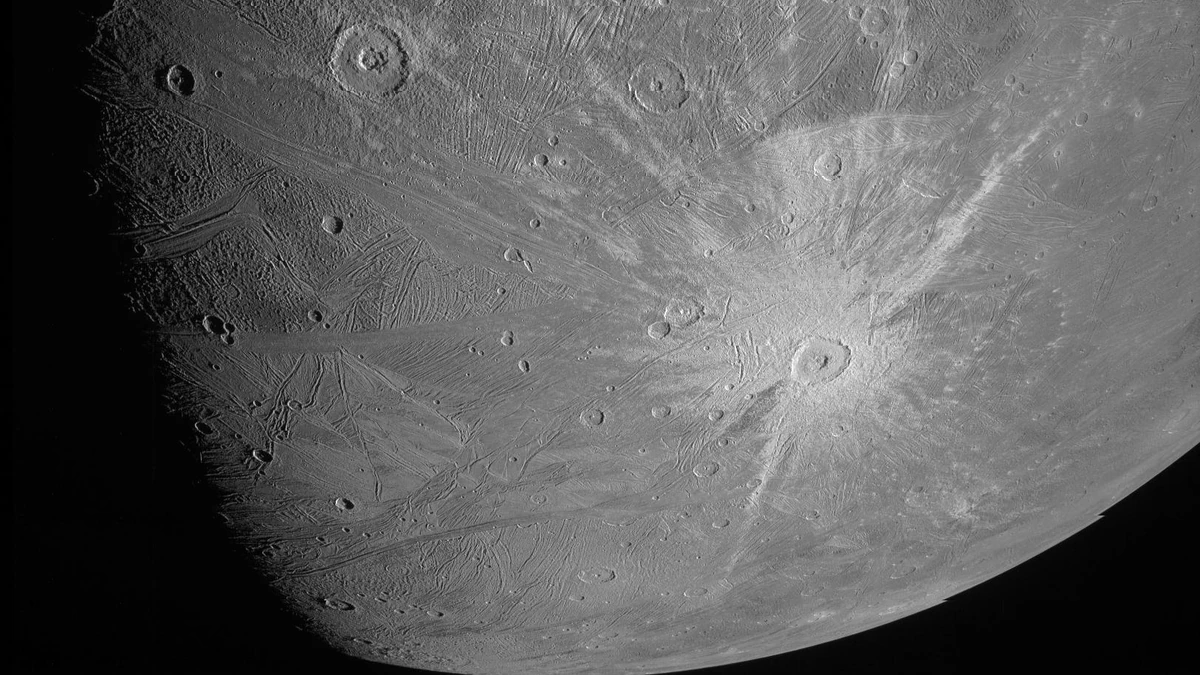
Juno's 2021 pass was a bonus, because that spacecraft's main job is studying Jupiter itself. The spacecraft built for Ganymede is Juice, the Jupiter Icy Moons Explorer. It launched on 14 April 2023 on an Ariane 5 rocket and has ten science instruments. Its third gravity assist, at Earth on 28 September 2026, was successful. After reaching Jupiter in July 2031, Juice will make 35 flybys of Ganymede, Europa and Callisto, and then settle into orbit around Ganymede in December 2034. ESA says it will be the first spacecraft to orbit a moon in the outer solar system, and its planned science lifetime is four years.
At Ganymede, Juice will measure the magnetic field, the ocean, the ice shell and the surface. If the ocean's magnetic signal is as small as the 2026 model suggests, a low orbit is exactly what it needs.
What you need to see Ganymede
Kit we've reviewed in full
Ganymede is one of the easiest moons to catch. Steady binoculars are enough, and more power only helps spread the moons away from Jupiter's glare.
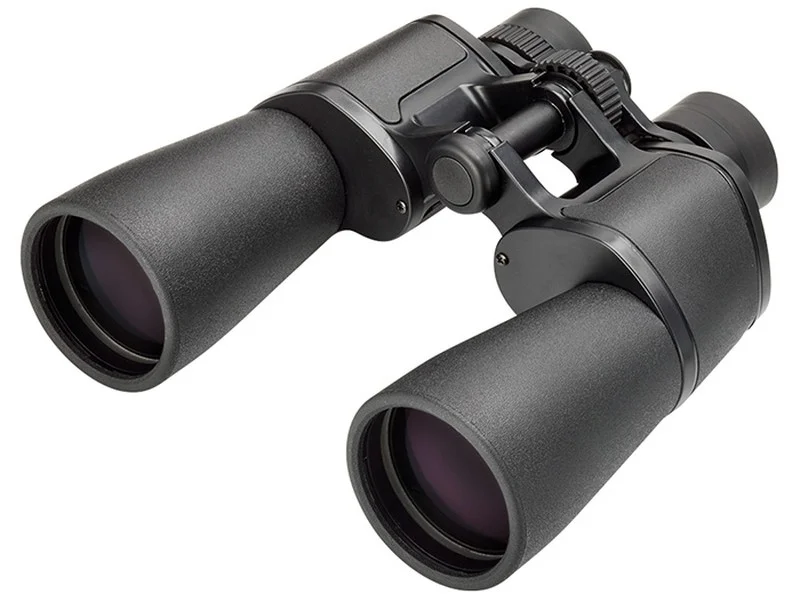
Ten times magnification and 50 mm lenses are plenty for Ganymede and Callisto as sharp dots either side of Jupiter. Lean on a wall or a car roof to keep the view still.
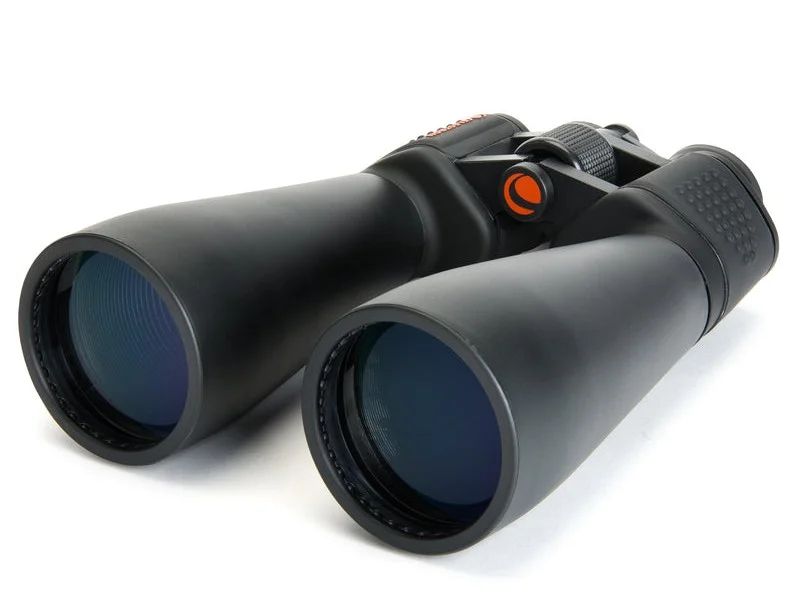
Fifteen times magnification pushes the moons further from Jupiter's glare and helps with Io and Europa. At this power you will want a tripod or a firm rest.
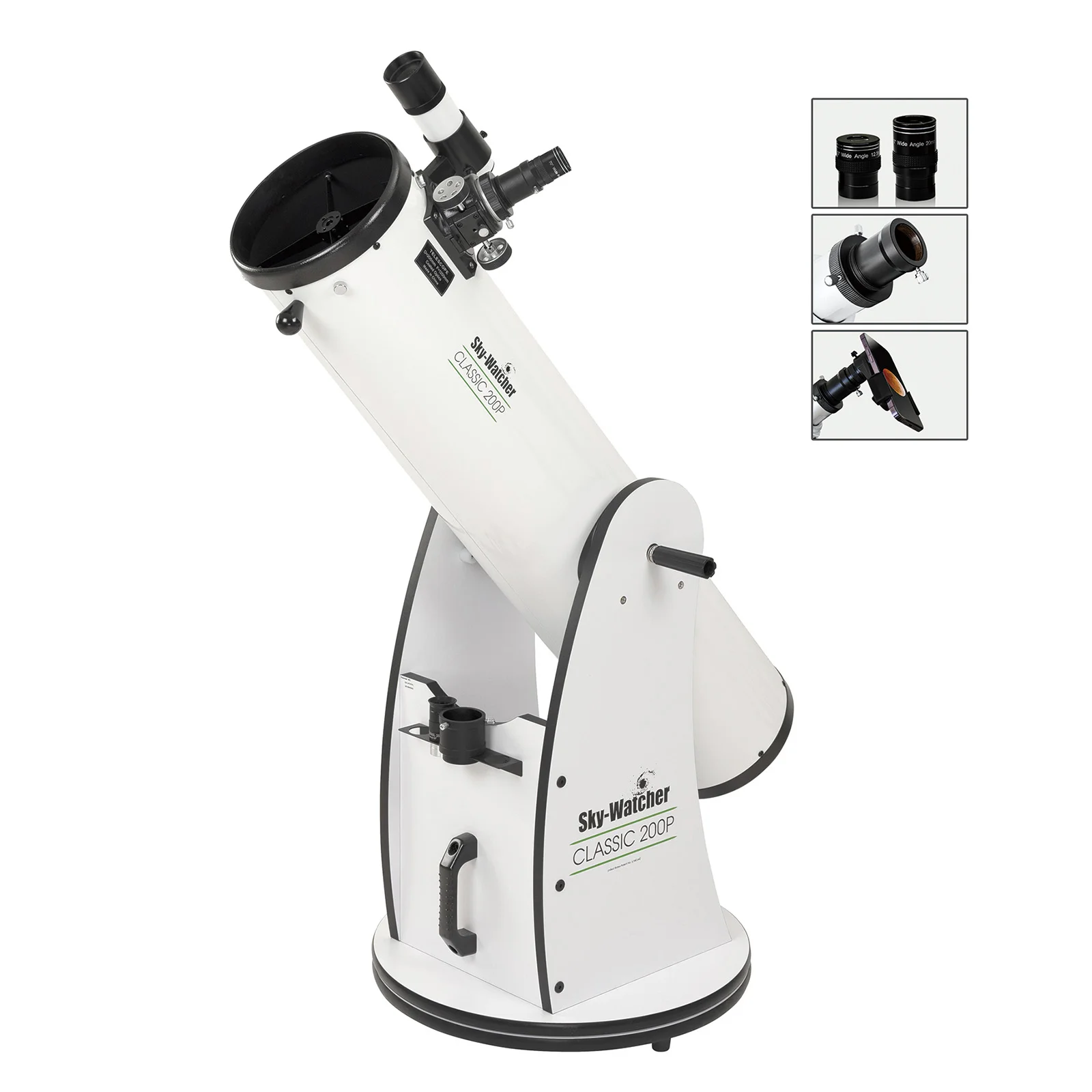
A telescope shows Jupiter's cloud belts as well as the moons, and at high power on a steady night Ganymede can look like a tiny disc instead of a point.
Affiliate links: you pay the same price, we earn a small commission that helps keep WatchTheStars free.
Frequently Asked Questions About Ganymede
Images: NASA/JPL and NASA/JPL-Caltech/SwRI/MSSS, with image processing of the crater view by Thomas Thomopoulos (CC BY). Main image: a natural-colour view of Ganymede from NASA's Galileo spacecraft, taken on 26 June 1996 (PIA00716). Sky positions for the UK computed with Skyfield and JPL Horizons.