Key takeaways
- Europa is Jupiter's ocean moon, about 3,122 km across, with a salty ocean under its ice that scientists believe holds twice as much water as all of Earth's oceans
- No life has been found on Europa, but NASA says it may be one of the most promising places in the solar system to look for it
- NASA's Europa Clipper launched on 14 October 2024, reaches Jupiter in April 2030 and will make 49 close flybys of Europa
- From the UK, Europa is a magnitude 6 dot beside Jupiter that steady 10x50 binoculars can pick out, and Jupiter reaches opposition on 11 February 2027
Jump to section 7 sections
Europa: Jupiter's Ocean Moon
Europa is a moon of Jupiter, about 3,122 km across, with a salty ocean hidden under a shell of ice. Scientists believe that ocean holds twice as much water as all of Earth's oceans put together, which makes Europa one of the most promising places in the solar system to look for life beyond Earth. NASA's Europa Clipper spacecraft is on its way to Jupiter now and arrives in April 2030.
Europa is the smallest of the four big moons that Galileo Galilei first saw around Jupiter in 1610, known as the Galilean moons. It is about 90% as wide as our own Moon and orbits Jupiter at an average distance of 671,000 km, a little under twice the distance between Earth and the Moon. One lap takes 3.55 days, and like our Moon it always keeps the same face turned towards its planet. Jupiter has 115 confirmed moons, and Europa is the one scientists keep coming back to.
Its surface is young. Fractures, ridges and bands criss-cross the ice, and NASA says they have erased terrain older than about 90 million years. Sunlight takes about 45 minutes to reach it, and the surface averages around −170°C.
Is There Life on Europa?
Nobody knows yet. No life has been found on Europa, and no spacecraft has been sent there to look for it. What NASA says is that Europa may be one of the most promising places in the solar system to find present-day conditions suitable for some form of life. Life as we know it needs liquid water, a source of energy and the right chemistry. Europa clearly has the water. The other two are still being worked out.
Europa is warm enough inside to keep its ocean liquid. Jupiter's gravity flexes the moon as it orbits, and that tidal heating is why it has not frozen solid. Most of what we know comes from NASA's Galileo orbiter and newer work with Hubble, Juno and the James Webb Space Telescope.
| When | Who | What was found |
|---|---|---|
| 1995–2003 | Galileo orbiter | Magnetic readings showed Jupiter's magnetic field being disrupted around Europa, pointing to a layer of salty water under the ice |
| 2013 | Hubble | Evidence that Europa might be venting water into space |
| 2019 | NASA-led team | Water vapour detected directly above Europa's surface for the first time |
| 29 September 2022 | Juno flyby | Close-up images, plus the readings behind two results below |
| September 2023 | Webb | Carbon dioxide in Tara Regio, likely from the ocean, and no sign of plume activity |
| 4 March 2024 | Juno result published | The ice surface makes about 12 kg of oxygen every second |
| 17 December 2025 | Juno result published | The ice shell is about 29 km thick in the region sampled |
| 6 January 2026 | Computer modelling study | Little to no active faulting on the seafloor today |
That last result cuts both ways. A team led by Paul Byrne at Washington University modelled Europa's rocky seafloor and concluded that it is probably geologically quiet, so hot, volcano-style vents like those on Earth's ocean floor are less likely. Gentler, lower-temperature flows of warm water could still support microbes like those in parts of Earth's deep oceans.
One myth is worth correcting. NASA says plainly that Europa Clipper is not a life detection mission. Its main goal is to find out whether there are places below Europa's surface that could support life.
How Thick Is the Ice on Europa?
Scientists have long estimated that Europa's ice shell is 15 to 25 km thick, floating on an ocean 60 to 150 km deep. Published estimates have ranged from 3 km to over 30 km. In December 2025 a team using Juno's microwave radiometer, a heat-sensing instrument that can see into ice, reported a shell about 29 km thick in the region Juno sampled during its 29 September 2022 flyby. The uncertainty is large, about 10 km either way. If the ice holds a modest amount of dissolved salt, as some models suggest, the figure drops by about 5 km.
The microwaves also found cracks, pores and voids in the upper ice. They are no bigger than a few centimetres but reach down for hundreds of metres, and they scatter the microwaves much as bubbles in an ice cube scatter light.
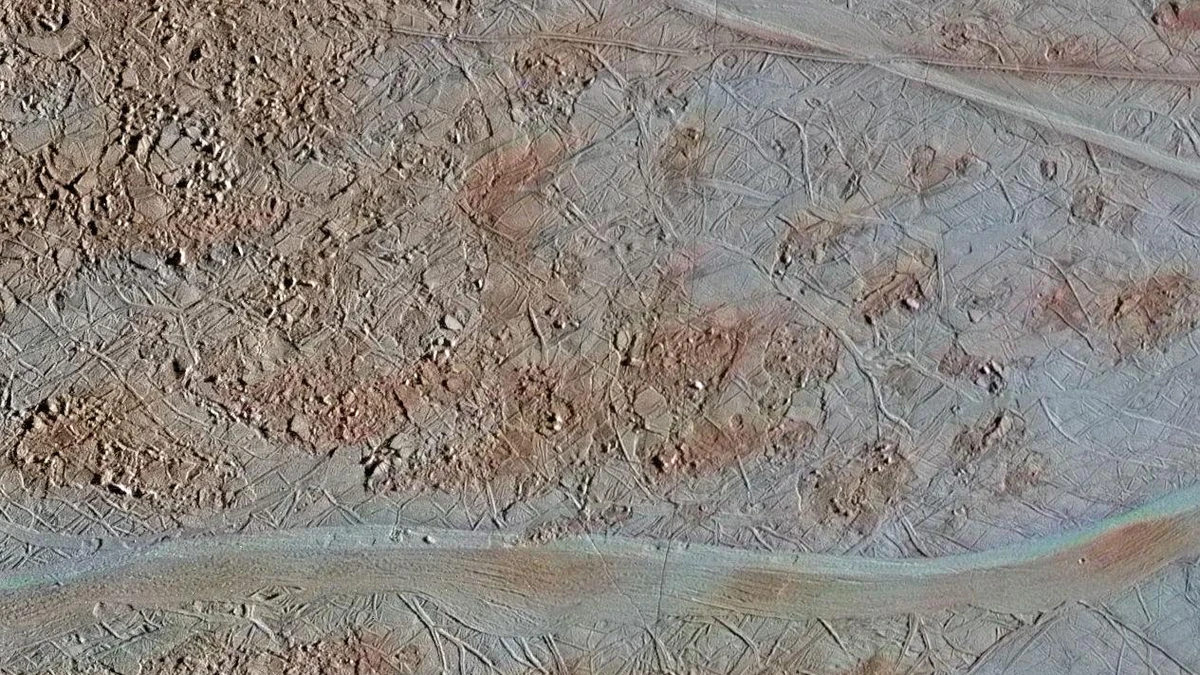
In chaos terrain, many of the blocks have slid sideways, turned or tilted before refreezing into place. Webb found its carbon dioxide, described below, in a region of this kind.
Does Europa Have Geysers? Plumes, Oxygen and Carbon
Possibly, but nobody has proved it. In 2013 Hubble found evidence that Europa might be venting water into space, and NASA says later Hubble observations suggested thin plumes of water thrown up to 160 km above the surface. In November 2019 a NASA-led team detected water vapour above Europa directly. Then in 2023 Webb looked for plume activity and found none, though its team stressed that this does not rule out occasional plumes. The evidence is mixed. If plumes do come from the ocean, a spacecraft could fly through one and sample it without landing.
Other clues are firmer. Jupiter's radiation breaks apart the water molecules in Europa's surface ice and leaves oxygen and hydrogen behind. During its flyby, Juno's particle detector measured how fast this happens. A team led by Jamey Szalay of Princeton University found that the ice makes about 12 kg of oxygen every second, give or take 6. Before Juno, estimates ranged from a few kilograms a second to over 1,000. If some of the oxygen retained in the ice worked its way into the ocean it could feed microbes, but that has not been shown. The result is a very thin oxygen atmosphere, nothing anyone could breathe.
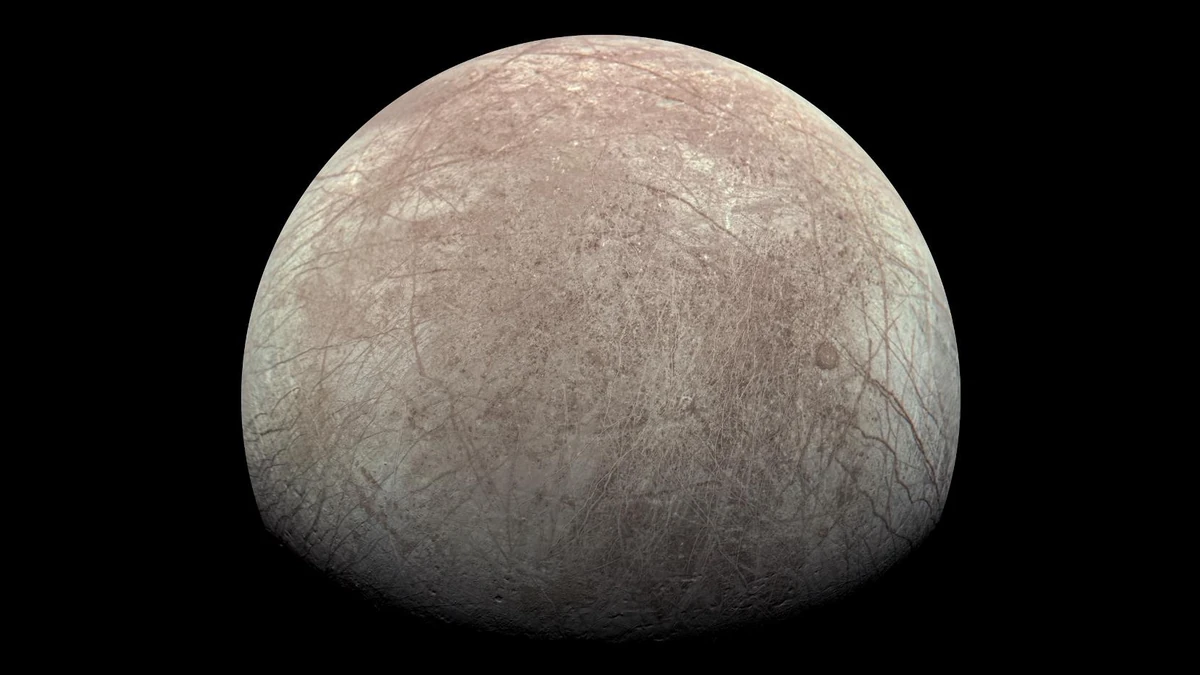
Webb found carbon on Europa too. In September 2023 two teams reported carbon dioxide concentrated in Tara Regio, a young region of chaos terrain, and concluded that it was probably supplied from the ocean on a geologically recent timescale. Carbon is a biologically essential element, so it is a useful sign, though it says nothing yet about whether anything lives there.
How Big Is Europa?
Europa is about 3,122 km across, about 90% as wide as our Moon and the smallest of the four Galilean moons. Its surface gravity is about 13% of Earth's, a little weaker than the pull at the surface of our Moon.
| Europa | Our Moon | |
|---|---|---|
| Diameter | 3,122 km | 3,475 km |
| Surface gravity | 1.31 m/s² | 1.62 m/s² |
| Distance from its planet | 671,000 km | 384,400 km |
| Time for one orbit | 3.55 days | 27.3 days |
Can You See Europa from the UK?
Yes, though it is one of the harder of Jupiter's big moons. Europa is about magnitude 6.2 now, brightening to about 5.4 by February 2027 as Jupiter comes closer to us, which is within reach of binoculars. The difficulty is the planet beside it. Jupiter is around 1,600 to 1,800 times brighter, and its glare swamps the moon when the two are close together. Europa takes 3.55 days to orbit, so it reaches its widest point on one side or the other about every 1.8 days. In between, it spends a lot of time too close to see.
Jupiter is in the morning sky this October. It rises earlier every night, so by December it is up from late evening, and by February it is out all night. It reaches opposition, at its brightest and biggest, on 11 February 2027. The table gives the window when Jupiter is more than 20° up and the sky is properly dark, for Birmingham. Plymouth and Edinburgh are within about 20 minutes. The clocks go back on 25 October 2026.
| Date | Best window (Birmingham) | Due south | Height when due south (Plymouth, Birmingham, Edinburgh) |
|---|---|---|---|
| 5 October 2026 | 04:40–06:00 BST | 09:45 BST (daylight) | 55°, 53°, 49° |
| 1 November 2026 | 02:15–05:45 GMT | 07:15 GMT (daylight) | 54°, 52°, 48° |
| 1 December 2026 | 00:30–06:30 GMT | 05:25 GMT | 53°, 51°, 47° |
| 1 January 2027 | 22:25–06:45 GMT | 03:20 GMT | 53°, 51°, 48° |
| 1 February 2027 | 20:10–06:05 GMT | 01:10 GMT | 54°, 52°, 49° |
| 11 February 2027 (opposition) | 19:25–05:20 GMT | 00:25 GMT | 55°, 53°, 49° |
Jupiter is brighter than any star, so it is easy to find. On 5 October it rises in the east-north-east at about 02:20 BST from Birmingham and by 05:30 BST is roughly 28° up in the east, about three fists held at arm's length. When due south this winter it is 47° to 55° up from the three cities, well clear of the horizon murk. The what you can see in the sky tonight page and UK night sky this week show where it sits on the day, and our guide to seeing Jupiter this year has the month-by-month detail.
The moon also strays further from Jupiter, and gets brighter, as winter goes on.
| Period | Europa's brightness (magnitude) | Widest distance from Jupiter's centre | Width of Jupiter's disc |
|---|---|---|---|
| 5–31 October 2026 | 6.2 to 6.1 | 169 arcseconds (2.8 arcminutes) | 34–36 arcseconds |
| November 2026 | 6.1 to 5.9 | 183 arcseconds (3.1 arcminutes) | 36–39 arcseconds |
| December 2026 | 5.9 to 5.7 | 200 arcseconds (3.3 arcminutes) | 39–43 arcseconds |
| January 2027 | 5.7 to 5.5 | 212 arcseconds (3.5 arcminutes) | 43–45 arcseconds |
| 1–12 February 2027 | 5.5 to 5.4 | 213 arcseconds (3.6 arcminutes) | 45 arcseconds |
In 10x binoculars, Europa at its widest in October sits about 28 arcminutes from Jupiter, close to the width of the full Moon to the naked eye. For about 70% of the time it is clear of Jupiter's disc and more than two Jupiter-widths from its centre.
Tips for spotting Europa
- Use at least 10x50 binoculars. Europa is hard in anything smaller. Our binocular astronomy guide covers holding them steady, and the best binoculars for stargazing page compares the options.
- Brace them. Rest your elbows on a wall, a gate or a car roof. A shaky view smears Jupiter's glare across the moon.
- Wait for it to move out. Europa is easiest at least two Jupiter-widths from the planet, which in October is about 70 arcseconds from its centre. A planetarium app such as Stellarium or SkySafari shows where all four moons are at any hour.
- Let your eyes settle. Give them a couple of minutes in the dark. Streetlights hurt, so see our UK dark sky sites map if your garden is bright.
- Try a telescope. New to them? Start with how to use a telescope. Europa shows only as a dot, with no surface detail.
Our Opticron Adventurer 10x50 review explains why 10x50 binoculars suit Jupiter so well, and they cost around £84 at First Light Optics. New to the sky? Try stargazing for beginners, and the astronomy events calendar lists Jupiter's opposition.
Europa Clipper: When Does It Reach Europa?
NASA's Europa Clipper launched on 14 October 2024 on a Falcon Heavy rocket from Kennedy Space Center in Florida. It is the largest spacecraft NASA has built for a planetary mission, spanning more than 30 m with its solar arrays out. Its nine instruments and a gravity experiment, including an ice-penetrating radar, will measure the ice, study the surface and look for plumes. It will make 49 close flybys, some as low as 25 km above the surface.
| Date | Milestone | Status on 5 October 2026 |
|---|---|---|
| 14 October 2024 | Launch | Done |
| 1 March 2025 | Mars gravity assist | Done |
| 3 December 2026 | Earth gravity assist | Next |
| April 2030 | Arrival at Jupiter | Planned |
| Spring 2031 | First Europa flyby | Planned |
| September 2034 | End of mission plan, deorbit into Ganymede | Planned |
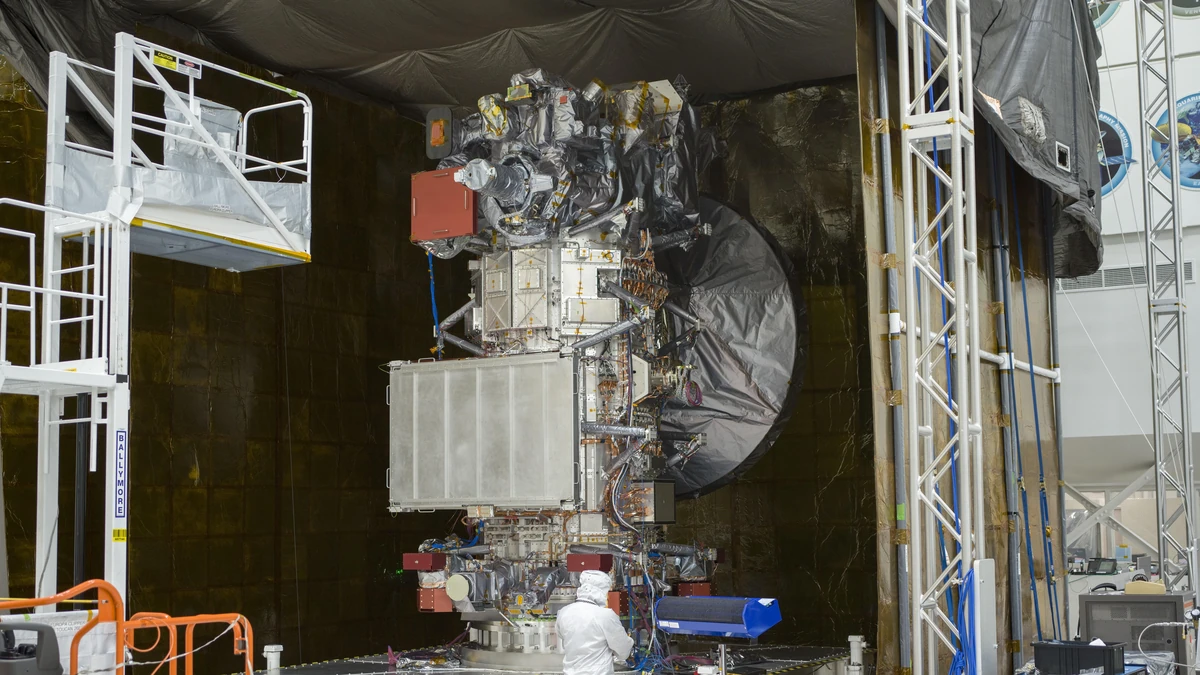
Clipper flies past Europa rather than orbiting it because of Jupiter's radiation. NASA says a spacecraft orbiting Europa might survive only months, while one orbiting Jupiter and swinging by Europa should last for years. The radiation belts can damage electronics.
The European Space Agency's Juice launched on 14 April 2023, completed its third gravity assist, a flyby of Earth, on 28 September 2026 and reaches Jupiter in July 2031. It will fly past Europa, Callisto and Ganymede, with 35 moon flybys in all, then orbit Ganymede. NASA's Juno flew past the small moon Thebe on 1 May 2026. NASA's Galileo, which reached Jupiter on 7 December 1995, was deliberately sent into the planet on 21 September 2003, when it ran out of propellant, to protect Europa. Next door at Jupiter, Io is the most volcanically active world in the solar system, and at Saturn Enceladus is another ocean moon.
What you need to see Europa
Kit we've reviewed in full
Europa is a faint dot next to a very bright planet. Binoculars are enough to find it on a good night, and a small telescope makes it a much more reliable catch.
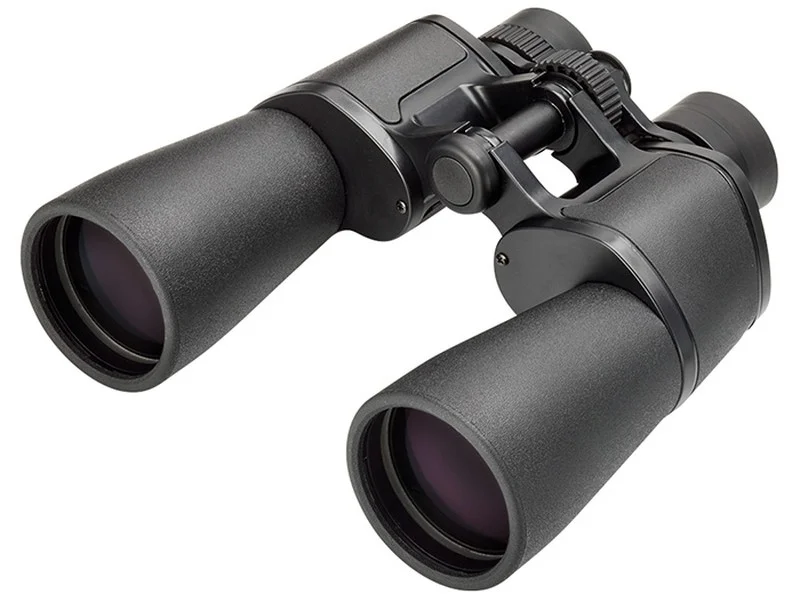
Ten times magnification and 50 mm lenses are what Jupiter's moons need. Rest your elbows on a wall or car roof, give your eyes a minute and look for Europa when it has moved well clear of the planet.
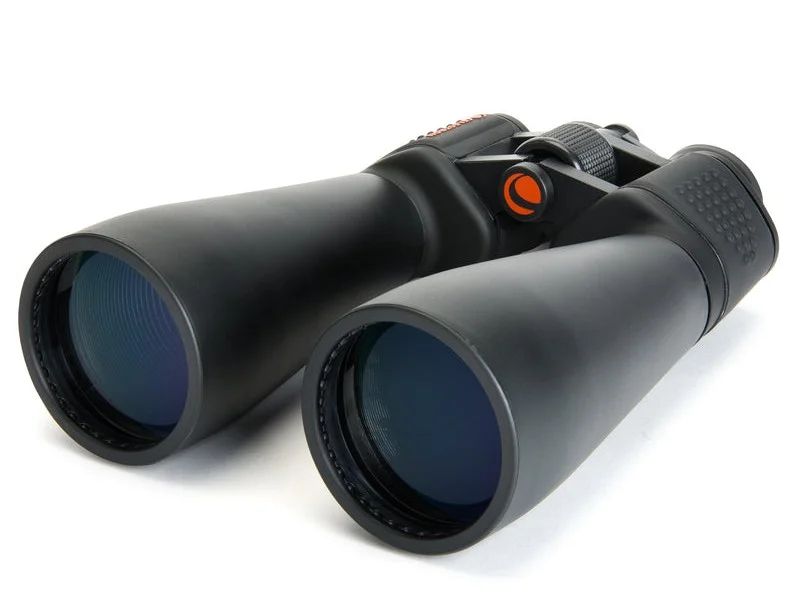
Fifteen times magnification spreads Europa a little further from Jupiter's glare and makes the planet's disc easier to see. They are heavy, so they need a tripod to be steady enough.
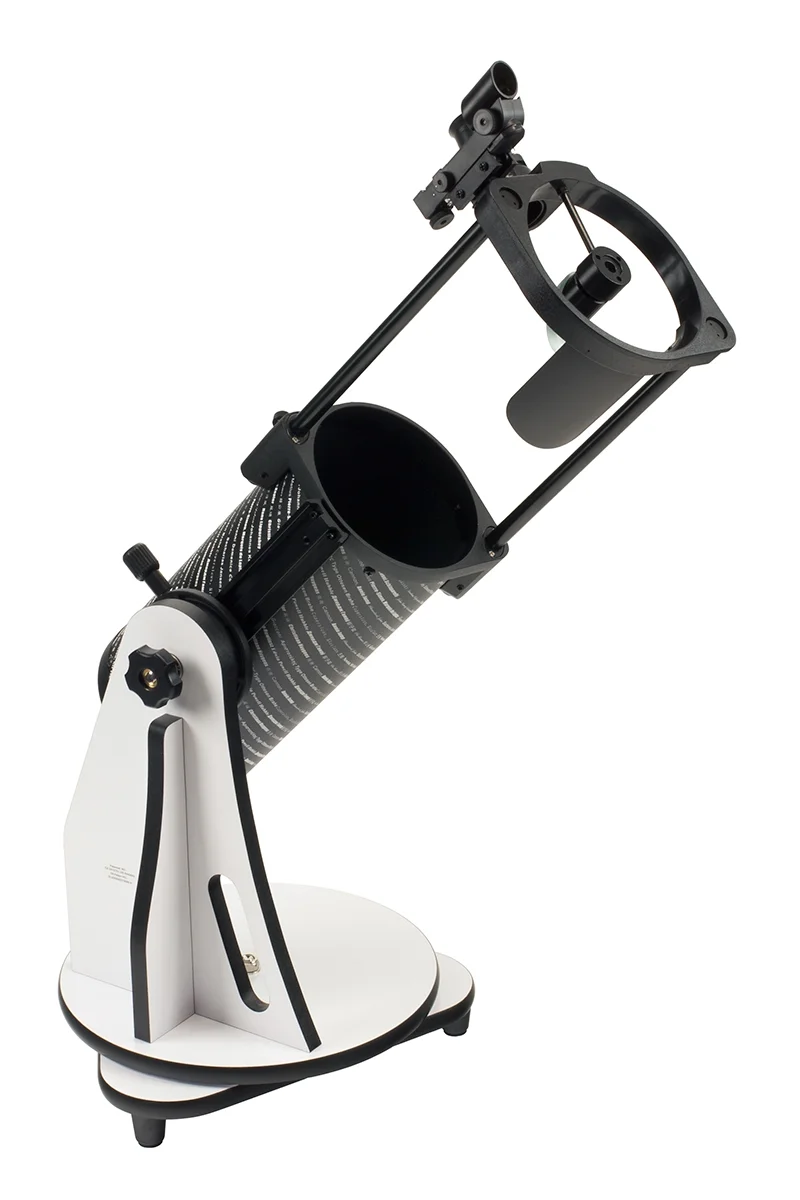
A 130 mm tabletop Dobsonian holds Jupiter steady at a comfortable magnification. Europa shows as a clear point wherever it sits, and Jupiter's two main cloud belts come into view as well.
Affiliate links: you pay the same price, we earn a small commission that helps keep WatchTheStars free.
Frequently Asked Questions About Europa
Images: NASA/JPL-Caltech/SETI Institute (Galileo images reprocessed by the SETI Institute), NASA/JPL-Caltech/SwRI/MSSS with processing by Kevin M. Gill (CC BY 3.0), and NASA/JPL-Caltech. Main image: a near-natural-colour view of Europa made from Galileo images taken in 1995 and 1998, with gaps filled in using simulated colour (PIA19048). Sky positions for the UK computed with Skyfield and JPL Horizons.