Key takeaways
- Miranda is a small icy moon of Uranus, about 470 km across, with a patchwork surface of cliffs, grooves and oval scars
- Verona Rupes on Miranda is often called the tallest known cliff in the solar system, but NASA's estimates of its height range from about 5 km to 20 km
- A 2024 study suggests Miranda may have had an ocean at least 100 km deep within the last 100–500 million years
- Miranda is about magnitude 16.4 and under 10 arcseconds from Uranus, which is about 20,000 times brighter, so it is beyond ordinary amateur telescopes
Jump to section 6 sections
Miranda: Uranus's Patchwork Moon
Miranda is a small, icy moon of Uranus, about 470 km across, with a patchwork surface of cliffs, grooves and oval scars. It is home to Verona Rupes, often called the tallest known cliff in the solar system, and a 2024 study suggests it may once have had an ocean under its ice. Only one spacecraft has ever seen Miranda up close, and from the UK it is far beyond what ordinary amateur telescopes can show.
Miranda is the innermost and smallest of the five major moons of Uranus. It orbits about 129,800 km from the planet, roughly a third of the distance from Earth to our own Moon, once every 1.41 days. It is about a seventh of the width of our Moon, and its gravity is less than 1% of Earth's, so a 70 kg person would weigh about half a kilogram there.
Gerard Kuiper discovered Miranda on 16 February 1948 at McDonald Observatory. NASA says it was the last moon of Uranus found before Voyager 2 arrived in 1986. It is named after the daughter of Prospero in Shakespeare's The Tempest, and NASA describes it this way: "Like Frankenstein's monster, Miranda looks like it was pieced together from parts that didn't quite merge properly."
Verona Rupes: The Tallest Known Cliff in the Solar System
Verona Rupes is a giant fault scarp, a cliff made where one block of crust dropped against another. NASA's Astronomy Picture of the Day for 27 November 2016 used this Voyager 2 image under the title "Verona Rupes: Tallest Known Cliff in the Solar System". No single height for it is settled.
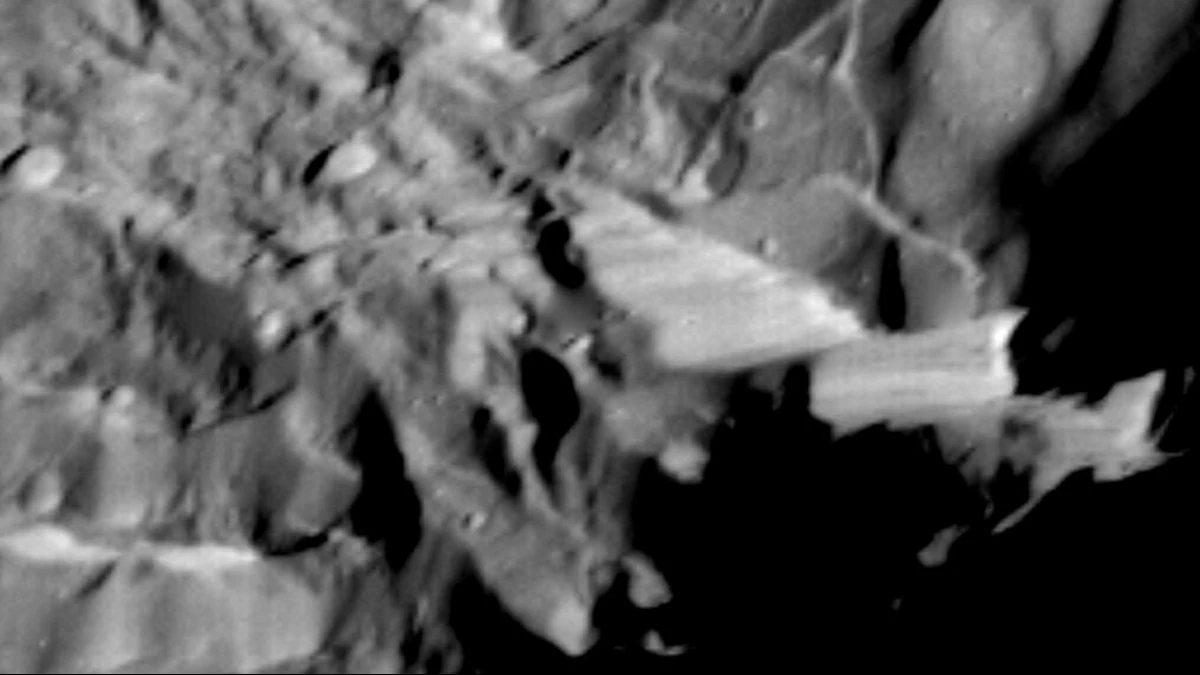
NASA's own pages give three different heights. The caption for this image says the largest fault scarp "may be 5 km (3 mi) high", higher than the walls of the Grand Canyon. NASA's Space Place says the cliff is estimated to be over six miles high, about 10 km. The Astronomy Picture of the Day says about 20 km. All of them rest on Voyager 2 pictures from 1986.
Miranda's gravity makes any fall slow. The table uses a gravity of 0.077 m/s², worked out from NASA's figures for Miranda's mass and size, and assumes a sheer drop.
| Height estimate | Source | Fall from the top | Speed at the bottom |
|---|---|---|---|
| 5 km | NASA caption for the Voyager 2 image | About 6 minutes | About 100 km/h |
| About 10 km | NASA Space Place | About 8.5 minutes | About 140 km/h |
| 20 km | NASA Astronomy Picture of the Day | About 12 minutes | About 200 km/h |
NASA's Miranda page quotes "a full 10 minutes" from the highest cliff, which sits between the second and third rows. How the cliff formed is unknown. The Astronomy Picture of the Day says it may be related to a large impact or to tectonic motion of the surface.
What Does the Surface of Miranda Look Like?
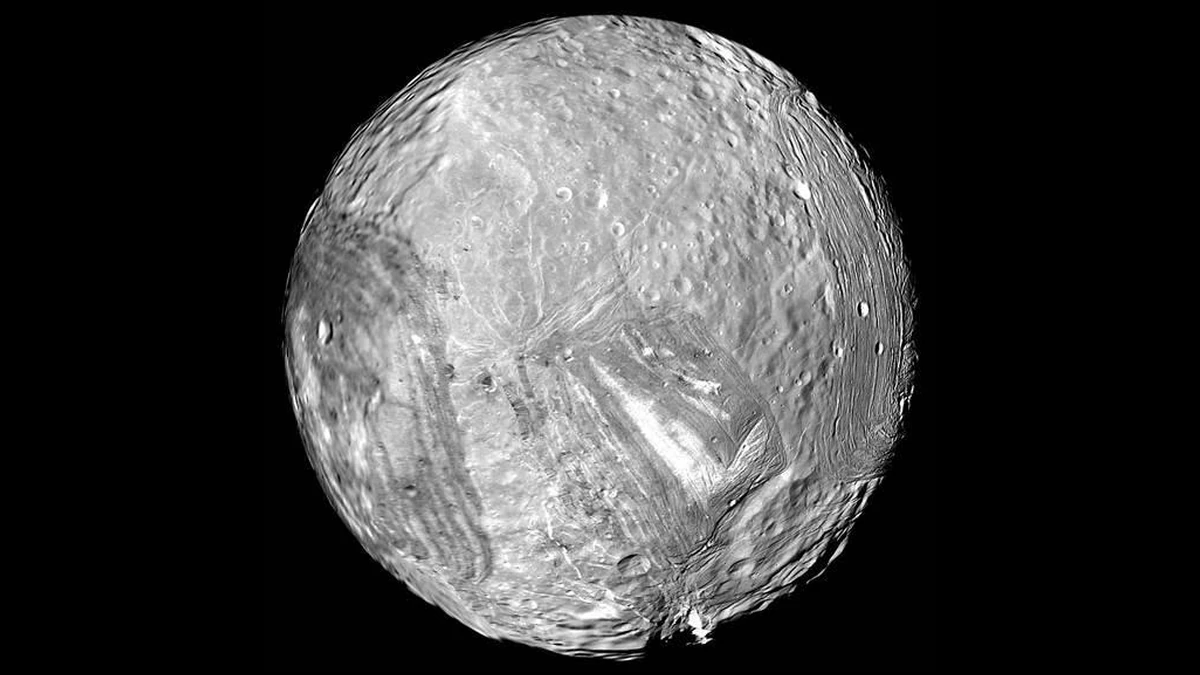
Miranda has two very different kinds of ground. One is old, heavily cratered, rolling terrain of fairly even brightness. The other is young and complex, with sets of bright and dark bands, scarps and ridges. The complex ground fills the oval regions at the top and bottom of the main image on this page and a V-shaped feature NASA calls the "chevron".
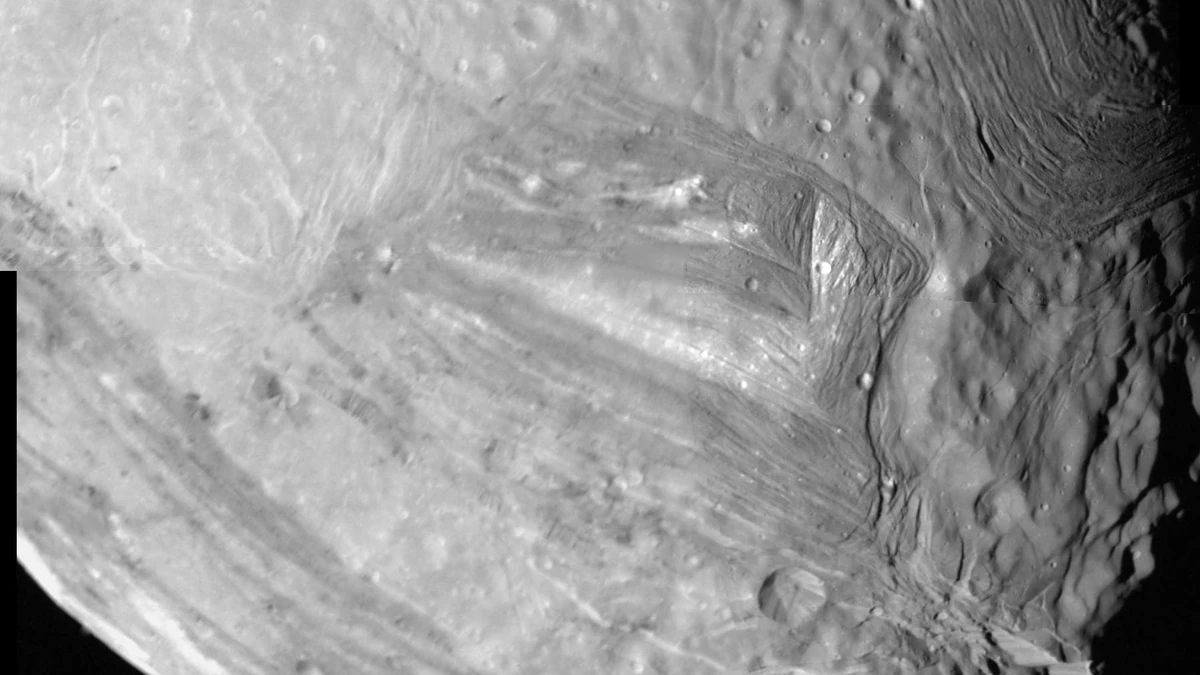
NASA says three large features, known as coronae, are unique among known objects in the solar system. They are lightly cratered collections of ridges and valleys, separated from the older, more heavily cratered terrain by sharp boundaries. Scientists disagree about how they formed. One idea is that Miranda was smashed apart in a colossal collision and the pieces reassembled haphazardly. Another, which NASA calls perhaps more likely, is that the coronae mark large meteorite strikes that partly melted the icy subsurface and let slushy water rise to the surface.
Does Miranda Have an Ocean?
Possibly, and if it does, probably a thin one. In October 2024 the Planetary Science Journal published a study by Strom, Nordheim, Patthoff and colleagues. They modelled the stresses that would crack Miranda's ice and compared them with the grooves and ridges Voyager 2 photographed. The results favour a crust no more than 30 km thick and make an ocean at least 100 km deep plausible at some point in the last 100–500 million years. With a radius of just 235 km, Miranda would have been almost half ocean.
Simulations suggest Miranda and its neighbours once shared an orbital resonance, a regular gravitational tug that flexes a moon and warms its inside. When that ended, the interior began to cool. The team does not think it has frozen solid, because a fully frozen ocean would have expanded and left telltale cracks that are not there. Miranda was not expected to have an ocean at all. With its small size and old age, scientists thought it would be a frozen ball of ice, much as they once thought of Enceladus.
Tom Nordheim of the Johns Hopkins University Applied Physics Laboratory is careful about it. "We won’t know for sure that it even has an ocean until we go back and collect more data," he said.
Can You See Miranda from the UK?
No. Miranda is beyond ordinary amateur telescopes, and beyond anything you would use by eye. Three numbers explain why, all worked out for October 2026 to February 2027.
- It is faint. Miranda shines at about magnitude 16.4. A common rule of thumb says that takes about 24 inches (60 cm) of aperture, under a dark sky with steady air.
- It is close to Uranus. Miranda is never more than about 9.7 arcseconds from the centre of Uranus. The planet's disc is only about 3.8 arcseconds wide, so Miranda sits about 8 arcseconds from its edge.
- Uranus is dazzling by comparison. Uranus is magnitude 5.6, about 20,000 times brighter than Miranda. Its scattered light swamps the moon.
Sharpness is not the limit. A 200 mm telescope has a resolving limit of about 0.6 arcseconds, far finer than the gap. Contrast and light are the limit. Reaching Miranda would take a very large telescope, a sensitive camera taking many short exposures, steady air and careful processing to remove Uranus's glow. We have not found a verified amateur image of Miranda, so treat it as a target for professional telescopes and spacecraft.
Uranus itself is easy. It reaches opposition on 25 November 2026 at 22:41 GMT, and it is then at its brightest and closest. It is due south at about 58° up from Birmingham, about 60° from Plymouth and about 55° from Edinburgh. Plymouth is about 9 minutes later than Birmingham and Edinburgh about 5 minutes later.
| Night starting | Uranus due south (Birmingham) | Uranus above 30° and sky dark (Birmingham) |
|---|---|---|
| 5 Oct 2026 | 04:22 BST on 6 Oct | 00:00–06:00 BST on 6 Oct |
| 25 Oct 2026 | 02:01 GMT on 26 Oct | 21:40–05:30 GMT |
| 25 Nov 2026 | 23:54 GMT | 19:30–04:20 GMT on 26 Nov |
| 1 Jan 2027 | 21:23 GMT | 17:30–01:50 GMT |
| 1 Feb 2027 | 19:18 GMT | 18:20–23:40 GMT |
| 1 Mar 2027 | 17:29 GMT | 19:00–21:50 GMT |
Dark means the Sun is more than 12° below the horizon. Plymouth and Edinburgh are within about 20 minutes of these windows, and by 1 April 2027 none is left. Opposition falls the day after the full Moon on 24 November, so moonlight will wash out the sky that week. New Moon is on 9 November and 9 December. Check tonight's Moon phase before you set up.
What you can see instead
- Uranus in binoculars. At magnitude 5.6 it looks like a faint star. A planetarium app or the Uranus guide for 2026 shows where to look. Our binocular astronomy guide covers the basics.
- Uranus in a telescope. A telescope shows a tiny disc, about 3.8 arcseconds across. Our how to use a telescope guide helps if you are new.
- Titania and Oberon. They shine at magnitude 13.8 and 14.0 and sit 29–33 and 39–44 arcseconds from Uranus. An 8-inch is the sensible minimum and a 10-inch is better.
What you can see in the sky tonight and the UK night sky this week list easier targets, and our UK dark sky sites map helps you find a darker site.
Missions to Miranda: Voyager 2 and a Uranus Orbiter
Voyager 2 is the only spacecraft that has visited Uranus and its moons. It launched on 20 August 1977 and passed Miranda at 28,260 km on 24 January 1986. Uranus was tipped with its south pole facing the Sun, so only the southern hemispheres of the planet and its moons were lit, and Voyager 2 saw only the southern side of Miranda.
| Date | What happened |
|---|---|
| 16 Feb 1948 | Gerard Kuiper discovers Miranda |
| 24 Jan 1986 | Voyager 2 passes Miranda at 28,260 km |
| Oct 2024 | A study finds a past ocean at least 100 km deep plausible on Miranda |
| 22 May 2026 | NASA's administrator asks for a feasibility evaluation of a flagship mission such as the Uranus Orbiter and Probe |
| 4 Jun 2026 | A Planetary Science Journal paper updates the Uranus Orbiter and Probe concept |
A Uranus Orbiter and Probe is described in that June 2026 paper as the "highest-priority strategic mission for the decade 2023–2032". The redesigned concept drops the Jupiter gravity assist and uses two next-generation radioisotope power sources. On 22 May 2026 NASA Administrator Jared Isaacman asked for an evaluation of "the feasibility of undertaking a new high priority decadal flagship mission, such as Uranus Orbiter and Probe". That is a feasibility study, not an approval. As of 5 October 2026 we found no approved launch for any mission to Uranus, so Miranda's northern half remains unseen. The Voyager 2 power fix is what keeps the one spacecraft that has been there running.
What you need to see Uranus and its brighter moons
Kit we've reviewed in full
Miranda itself is beyond amateur telescopes, so this kit is for what you can reach: Uranus, and on a good night Titania and Oberon.
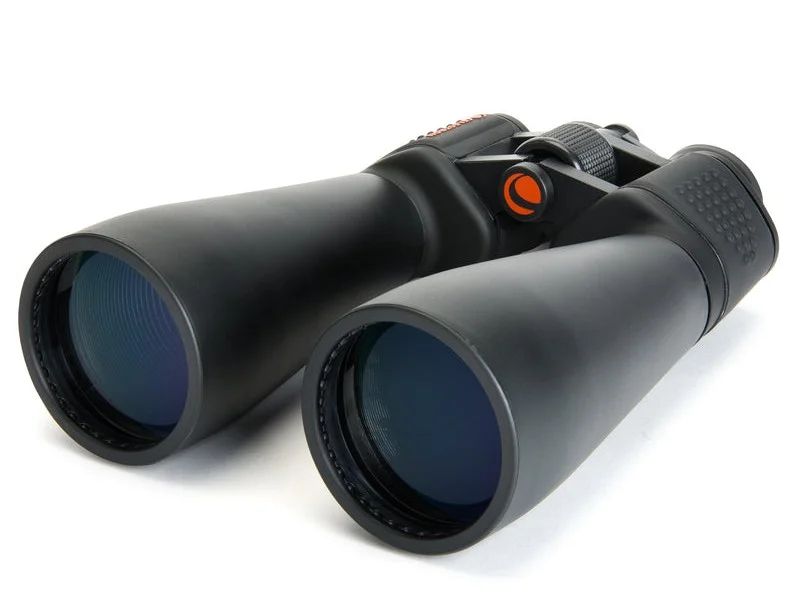
At magnitude 5.6, Uranus is an easy target for 70 mm binoculars. It looks like a faint star, so use a chart or planetarium app to pick it out. Mount them on a tripod for a steady view.

Sky-Watcher Skyliner 250PX FlexTube
Ten inches reaches magnitude 14.5 by the usual rule of thumb, just enough for Titania (13.8) and Oberon (14.0). They sit 29–44 arcseconds from Uranus, which is a much easier gap than Miranda's.
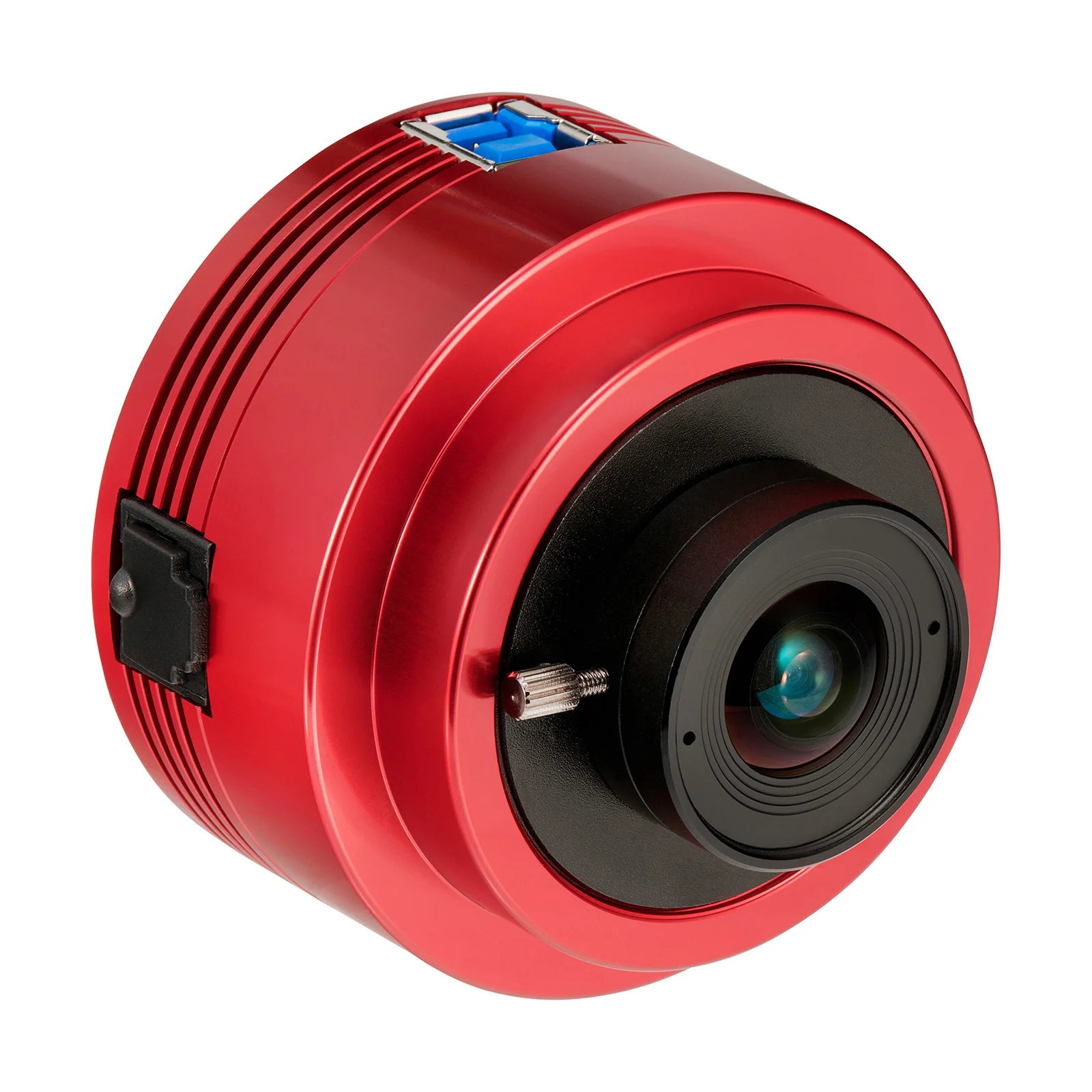
ZWO ASI662MC Colour Planetary Camera
A sensitive colour camera records fainter objects than your eye by stacking many short exposures. It is the next step for Uranus's moons, though Miranda would also need a large telescope and processing to tame Uranus's glow.
Affiliate links: you pay the same price, we earn a small commission that helps keep WatchTheStars free.
Frequently Asked Questions About Miranda
Images: NASA/JPL, NASA/JPL/USGS and NASA/JPL-Caltech, Voyager 2 mission. Main image: a south polar view of Miranda, a computer-assembled mosaic of nine Voyager 2 images from 24 January 1986, with gaps along the edge filled from lower-resolution images (PIA01490). The Verona Rupes image is a crop enlarged by about 18%. Sky positions for the UK computed with Skyfield and JPL Horizons.