Voyager 1 and 2: where they are now, and how they got there
Two probes the size of a small car, launched from Florida sixteen days apart in the summer of 1977, built to last about five years. Between them they flew past all four giant planets, carried a golden record out of the Solar System and became the first things humans have sent into interstellar space. They are still sending data home today.
Where are Voyager 1 and 2 now?
Both are in interstellar space, the gap between the stars, well past the edge of the Sun's influence. Voyager 1 is the most distant object humans have ever made.
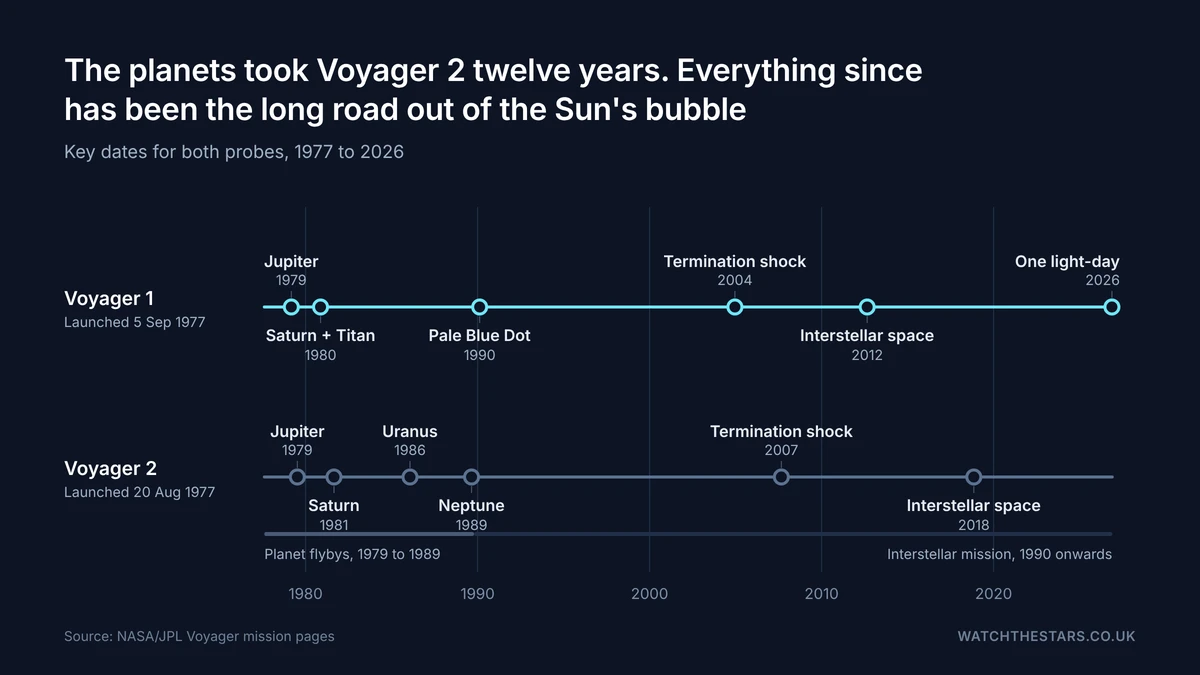
On 18 November 2026 Voyager 1 became the first spacecraft to reach one light-day from Earth. NASA put the moment at 10:16am GMT, when it was 25.9 billion km (16.1 billion miles) away. A radio command now takes a full 24 hours to get there, and the reply takes another 24 hours to come back. We covered the milestone in Voyager 1 reaches one light-day from Earth.
Voyager 2 is further back on a different path, heading south below the plane of the planets. It is about 21.7 billion km from Earth, and its signals take just over 20 hours each way. It won't reach the one light-day mark until around 2035.
The numbers on 18 November 2026
- Voyager 1 from Earth
- 25.9 billion km (173.1 AU)
- Voyager 1 speed away from the Sun
- 16.9 km/s, about 61,000 km/h
- Voyager 2 from Earth
- 21.7 billion km (144.9 AU)
- Voyager 2 speed away from the Sun
- 15.0 km/s, about 54,000 km/h
- One-way signal time
- 24.0 hours (V1), 20.1 hours (V2)
Distances from JPL's Horizons system. An AU is the average distance from Earth to the Sun, about 150 million km.
Both probes have crossed the heliopause, the boundary where the solar wind gives way to the thin gas between the stars. Voyager 1 crossed it on 25 August 2012, and Voyager 2 followed on 5 November 2018. They are now sampling the Local Interstellar Cloud directly, the wisp of gas the Sun is drifting through. Neither has left the Solar System in the widest sense, though. The Oort Cloud of icy comets begins hundreds of times further out, and it will take each probe around 300 years to reach its inner edge.
When did Voyager 1 and 2 launch, and from where?
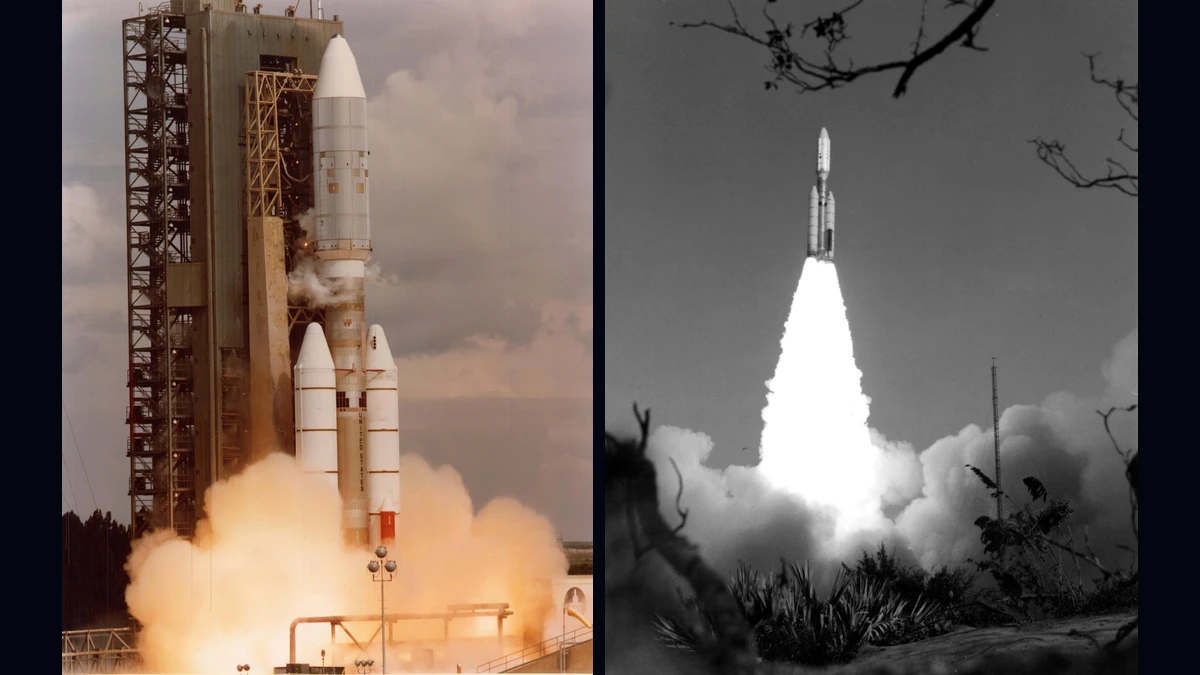
Voyager 2 went first, on 20 August 1977. Voyager 1 followed on 5 September 1977. Both left from the same launch pad in Florida.
The two probes lifted off from Launch Complex 41 at Cape Canaveral on Titan IIIE-Centaur rockets, the most powerful American launchers of the day. Voyager 2 left at 10:29am local time on 20 August. Voyager 1 left at 8:56am on 5 September.
If the numbering looks back to front, it is deliberate. Voyager 1 was put on a faster, shorter path and would overtake its twin before reaching Jupiter, so it got the lower number. By December 1977 it was ahead, and it reached Jupiter four months before Voyager 2.
Each spacecraft weighs well under a tonne and is roughly the size of a small car, with a 3.7-metre dish aerial that still points back at Earth. They have no solar panels. Sunlight out past Jupiter is too weak to be much use, so they run on three plutonium generators each, turning the heat of radioactive decay into electricity. The computers have about 70 kilobytes of memory between them, less than a single photo on your phone.
What was the Voyager mission originally for?
A quick trip to Jupiter and Saturn. Everything after that was a bonus nobody could promise at the time.
The idea goes back to 1965, when Gary Flandro, a graduate student working at NASA's Jet Propulsion Laboratory, noticed that the outer planets would line up in the late 1970s in a way that happens only about once every 175 years. A spacecraft launched at the right moment could swing past Jupiter, use its gravity to pick up speed and bend its path, then do the same at Saturn, Uranus and Neptune. A journey that would otherwise take 30 years could be done in about 12.
NASA drew up a "Grand Tour" with four large spacecraft to make the most of it. In January 1972 it cancelled the plan, mainly because the cost was heading for $1 billion. What survived was a cheaper mission to Jupiter and Saturn only, called Mariner Jupiter-Saturn, built on the design of the earlier Mariner probes and meant to last about four to five years. The two spacecraft were known as Mariner 11 and Mariner 12 until 7 March 1977, when NASA renamed them Voyager.
The engineers kept the Grand Tour alive quietly. Voyager 2's path was chosen so that, if it was healthy after Saturn, it could carry on to Uranus and Neptune. Voyager 1 had a different job. Its route took it close past Saturn's big moon Titan, the only moon with a thick atmosphere, and that flyby flung it up out of the plane of the planets. It could never visit another planet after that, and the scientists decided Titan was worth it.
What did Voyager 1 and 2 discover at the planets?
More than any planetary mission before them. Much of what is in school textbooks about the outer planets comes from these two flybys.
Jupiter, 1979. Voyager 1 passed on 5 March and Voyager 2 on 9 July. The biggest surprise was on the moon Io, where an engineer looking at a navigation image spotted a plume above the edge of the moon. It was a volcano erupting, the first active volcano ever seen beyond Earth, and Io turned out to have several. The probes also found a faint ring around Jupiter and showed the Great Red Spot as a giant storm turning anticlockwise.
Saturn, 1980 and 1981. Voyager 1 arrived on 12 November 1980 and Voyager 2 in August 1981. The rings turned out to be made of thousands of narrow ringlets, with dark "spokes" drifting across them. Titan's atmosphere proved to be thicker than Earth's and mostly nitrogen, but so hazy that Voyager 1's cameras couldn't see the surface.
Uranus, 1986. Voyager 2 flew past on 24 January 1986, the only visit Uranus has ever had. It found 10 new moons and two new rings, and a magnetic field tipped a long way from the planet's spin axis. Its pictures of the moon Miranda, with cliffs and grooves that look stitched together from different worlds, are still the only close-up views we have.
Neptune, 1989. On 25 August 1989 Voyager 2 passed just 4,800 km above Neptune's cloud tops, the closest approach of the whole mission. It found the Great Dark Spot, the fastest winds measured on any planet, and nitrogen geysers on the moon Triton. No spacecraft has been back to Uranus or Neptune since.
Voyager Golden Record: what's on it?
A 12-inch gold-plated copper record fixed to the side of each probe, meant for anyone who might one day find it.
A committee chaired by the astronomer Carl Sagan of Cornell University chose what went on the record, with only weeks to do it. Ann Druyan was its creative director. The finished record holds 115 images encoded as sound, from diagrams of DNA to people eating and a supermarket aisle, along with natural sounds such as surf, wind, thunder and birdsong. There are spoken greetings in 55 languages and 90 minutes of music, running from Bach and Beethoven to Javanese gamelan, Peruvian panpipes and Chuck Berry's "Johnny B. Goode".
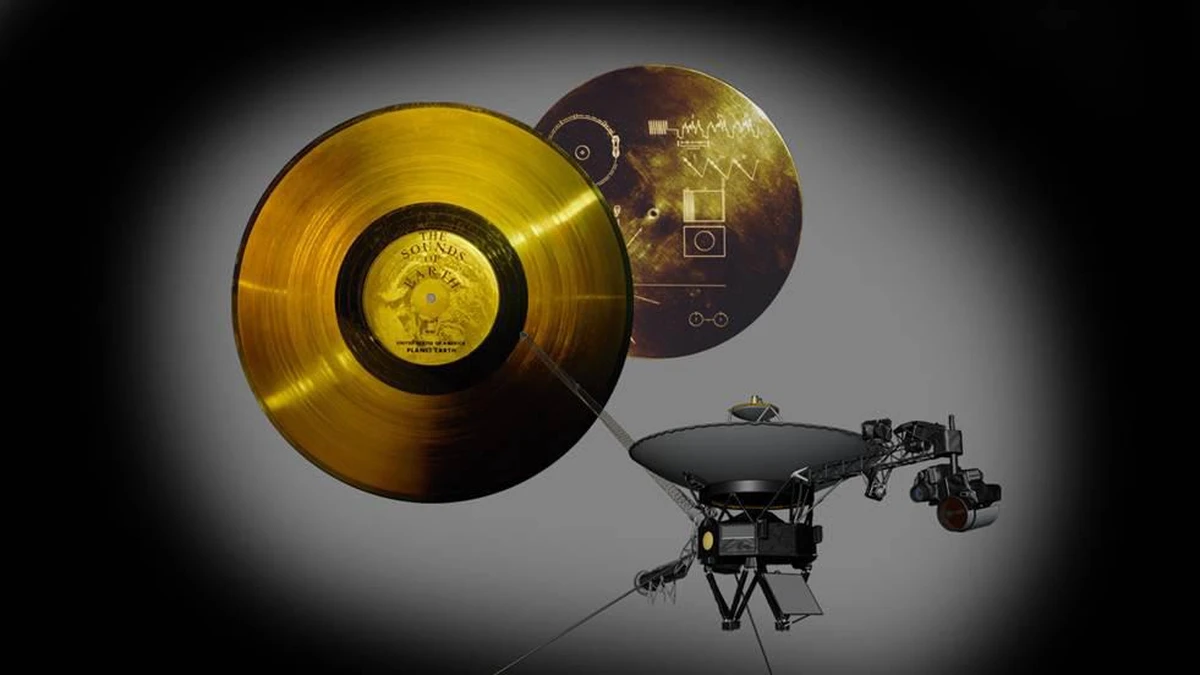
The record is designed to play at 16⅔ revolutions per minute. Each one sits in an aluminium case with a cartridge and a needle, and the cover is engraved in symbols with instructions for playing it and a map that pins down the Sun's position using 14 pulsars. Sagan was frank that the chance of anyone finding it was tiny. He compared it to launching a bottle into the cosmic ocean, and said the launch itself said something very hopeful about life on this planet.
Pale Blue Dot: Voyager 1's last photos
Before its cameras were switched off for good, Voyager 1 turned round and photographed the planets from 6 billion km away.
It was Sagan's idea, and he had to push NASA for years to get it, because pointing the cameras back towards the Sun risked damaging them. On 14 February 1990 Voyager 1 took a mosaic of 60 frames, the "Family Portrait", showing six planets. In one frame Earth is a speck less than a pixel across, sitting in a band of scattered sunlight.
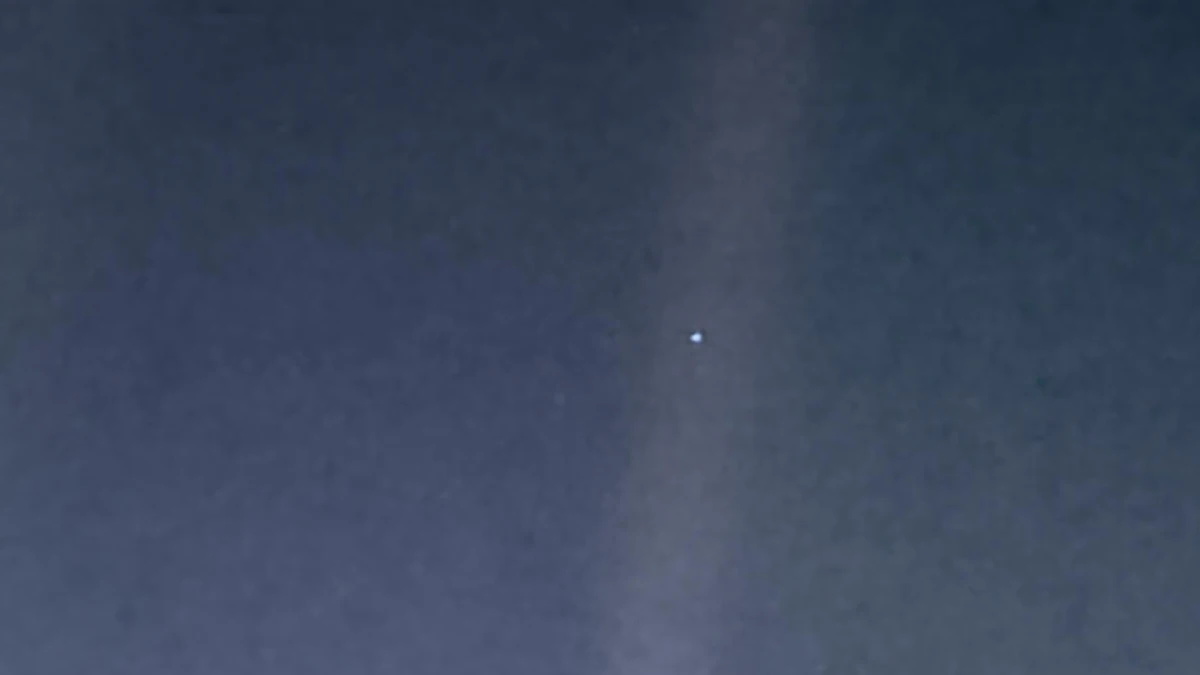
Sagan wrote about it in his 1994 book Pale Blue Dot: "Look again at that dot. That's here. That's home. That's us." The cameras were switched off 34 minutes after the Earth frames were taken, to save power for the long journey, and no Voyager has taken a photo since.
Voyager in Star Trek and popular culture
Few missions have reached as far into films, music and people's imaginations.
Star Trek: The Motion Picture (1979). The first Star Trek film came out the year Voyager reached Jupiter, and its plot turns on a probe like it. A vast alien cloud called V'Ger heads for Earth, destroying everything in its path. Captain Kirk's crew discover that at its heart is a fictional NASA probe, Voyager 6, which fell into a black hole, was found by a race of machines and was rebuilt to complete its programmed task: learn all that is learnable and return the information to its creator. The name V'Ger is what is left of "Voyager" on its battered nameplate. There was never a real Voyager 6. NASA only ever built and flew two.
The record lives on. In 2017, for the 40th anniversary, the Golden Record was released on vinyl for the first time after a crowdfunding campaign. The record and its music list still turn up in classrooms, songs, novels and documentaries, usually as a starting point for the question of what you would send.
The Pale Blue Dot became one of the most quoted passages in popular science, and NASA reissued the photo for its 30th anniversary in 2020.
The light-day. On 17 November 2026, the eve of Voyager 1 reaching one light-day, NASA marked the moment in New York with Ann Druyan speaking before the Empire State Building was lit up. People around the world joined NASA's "Shine Bright" event by pointing torches and phone lights towards the spacecraft's place in the sky.
There is something about the Voyagers that keeps people coming back to them. They were built with 1970s technology, they are still working, and a small team at JPL keeps them going by sending commands that take a day to arrive. When Voyager 1 started sending back garbled data in November 2023, engineers traced it to a single failed memory chip in one of its computers. Working 24 billion km away, they moved the affected code into other parts of the memory, and by June 2024 all its instruments were sending proper science data again.
How long will Voyager 1 and 2 keep working?
Probably into the early 2030s. Power, not wear and tear, is what will end them.
At launch each probe's plutonium generators gave about 470 watts. Plutonium-238 decays steadily, so the output drops by about 4 watts a year. To keep going, the team has switched off heaters, back-up systems and, one at a time, science instruments. Each probe launched with 10 instrument sets. Voyager 1 lost its cosmic ray instrument in February 2025 and its low-energy charged particles instrument on 17 April 2026, leaving two: a magnetometer and a plasma wave instrument. Voyager 2 still has three: a magnetometer, a plasma wave instrument and its cosmic ray instrument.
That cosmic ray instrument was due to go in 2026 too. In mid-2026 the team tried an operation they nicknamed the "Big Bang", switching off several power-hungry devices at once and switching on lower-power ones to do the same work. It bought Voyager 2's instruments at least another year, and the story is in how NASA's 'Big Bang' saved Voyager 2's instruments.
NASA expects at least one instrument on one or both probes to keep working into the 2030s. After that the transmitters will keep sending a carrier signal for a while, and then they will go quiet. The probes will carry on regardless. In about 40,000 years Voyager 1 will pass about 1.6 light-years from a star called Gliese 445, and Voyager 2 will pass about 1.7 light-years from Ross 248. For comparison, the nearest star to the Sun, Alpha Centauri, is 4.4 light-years away.
Can you see Voyager 1 from the UK?
You can't see the spacecraft, but you can point straight at it.
No telescope on Earth could pick out Voyager 1. It is a few metres across and 25.9 billion km away, and it gives off no light of its own. What you can do is find its spot in the sky. Voyager 1 lies in the constellation Ophiuchus, just over the border from Hercules, about 2° below Rasalgethi, the star that marks Hercules' head, and 5° from Rasalhague, the brightest star in Ophiuchus. Its position barely changes from year to year, so these directions will hold for a long time.
Where to point, worked out for UK latitudes
- Best time of year
- July evenings: due south at about 10:50pm BST in mid-July
- Highest it gets
- 50° in central England, 52° in Plymouth, 46° in Edinburgh
- Mid-November
- 32° up in the south-west at 5pm GMT, setting about 8:40pm (Edinburgh 8:55pm)
- Winter
- Low in the west after sunset; it never gets closer than about 35° to the Sun
- Voyager 2
- Far in the southern sky, in Pavo. It never rises anywhere in the UK
Positions from JPL Horizons, worked out for Birmingham, Plymouth and Edinburgh with Skyfield.
Pointing a finger at a dot you can't see may sound pointless, but it changes how you look at that part of the sky. If you are new to finding your way around, our stargazing for beginners guide covers star-hopping from bright stars, and the UK night sky this week lists what else is up. Check what you can see in the sky tonight before heading out.
See the worlds the Voyagers saw
Kit we've reviewed in full
You can't see Voyager 1 or 2 with any telescope. They are far too small and far too faint. What you can see from a UK garden are the planets they flew past. This winter Saturn is in the evening sky, due south at about 7pm in mid-December, and Jupiter comes to opposition on 11 February 2027, when it is up all night and at its biggest and brightest.
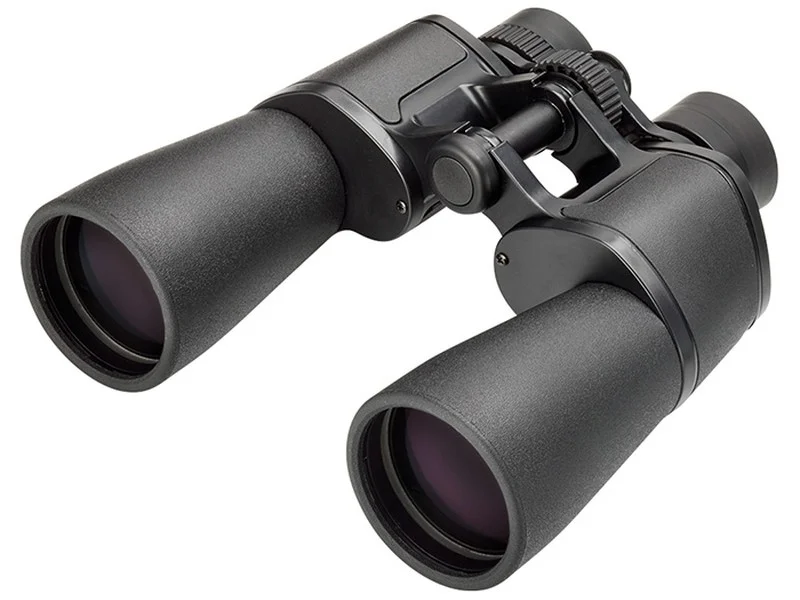
Hold 10×50s steady, or rest them on a fence, and Jupiter shows up to four tiny points of light in a line: Io, Europa, Ganymede and Callisto. These are the four moons Voyager 1 and 2 photographed close up in 1979, including the volcanoes on Io.
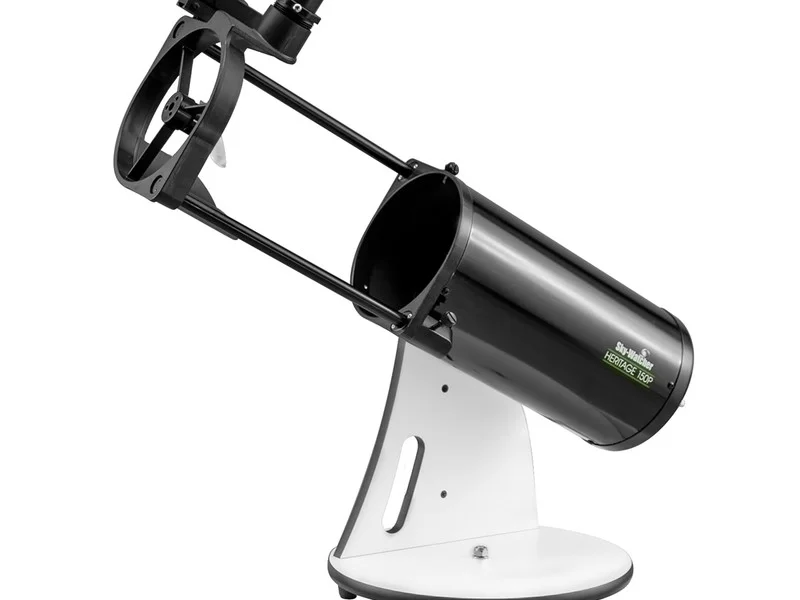
A 150mm tabletop Dobsonian at 75× to 100× shows Saturn's rings and the planet's shadow on them, with Titan as a bright star-like dot nearby. Titan's haze is the reason Voyager 1 never went on to Uranus and Neptune.
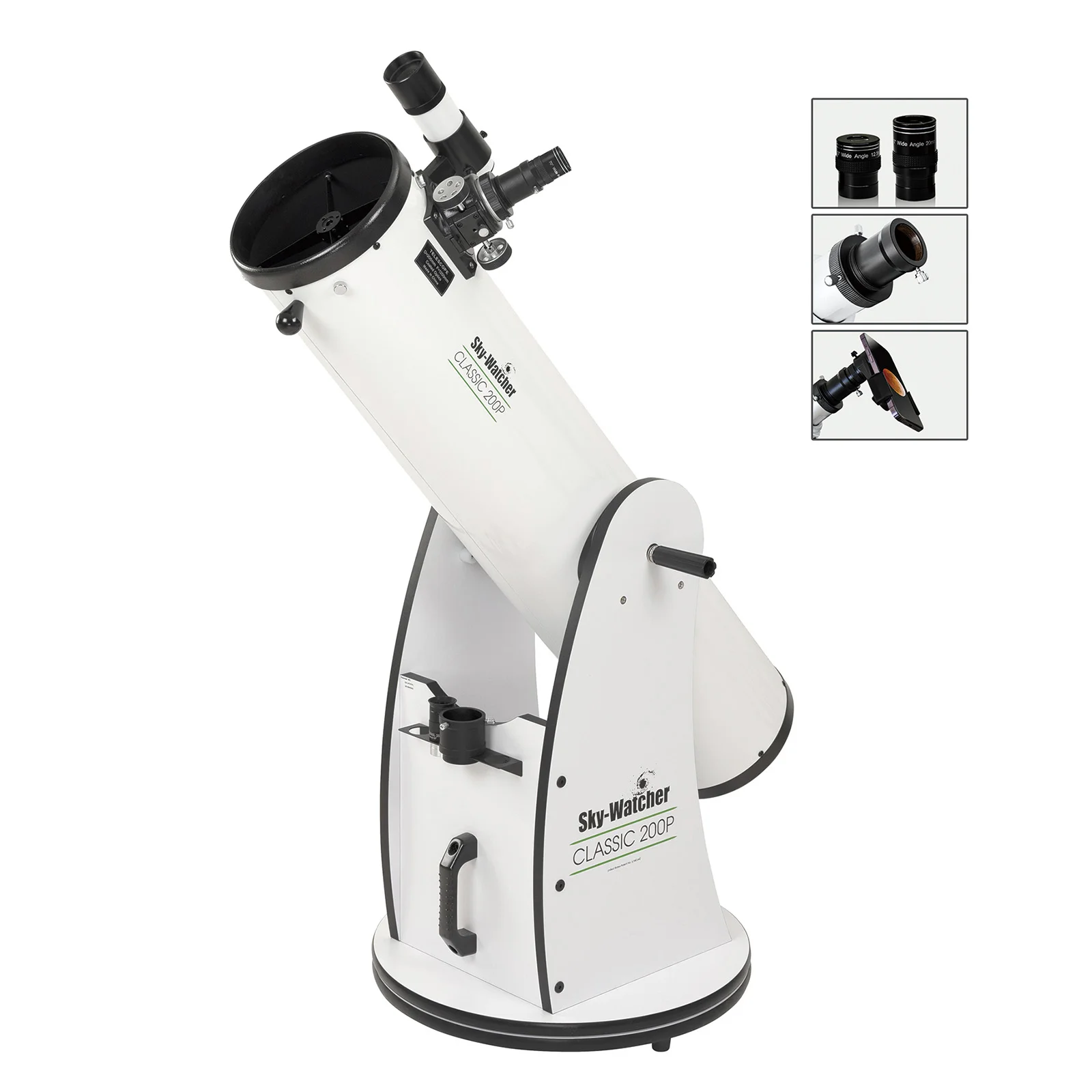
An 8-inch Dobsonian turns Uranus into a small pale green-blue disc and shows Neptune as a tiny blue one. That is as close as anyone has got to either planet since Voyager 2's flybys in 1986 and 1989.
Affiliate links: you pay the same price, we earn a small commission that helps keep WatchTheStars free.
Saturn is the easy one this winter, high in the south in the early evening until February. Jupiter climbs into the evening sky in the new year and is at its best around opposition on 11 February 2027. For Uranus and Neptune you'll need a finder chart and some patience, plus one of the best beginner telescopes UK buyers rate, or the best binoculars for stargazing for Uranus alone.
Header image: artist's rendering of a Voyager spacecraft, NASA/JPL-Caltech (PIA14111).