Celestron telescopes UK: NexStar, StarSense Explorer and SkyMaster explained
Celestron telescopes are the computerised choice: the NexStar 6SE at £1,199 is the best GoTo telescope for UK beginners, and the StarSense Explorer DX 130AZ at £429 is the best telescope that uses your phone to find targets. The range names say what each one does: NexStar SE is a GoTo Schmidt-Cassegrain, StarSense Explorer is a manual telescope with phone-guided pointing, and SkyMaster is the astronomy binocular range.
This page covers every Celestron product we review, with prices read from our product data and last checked on 2 November 2026. If value per pound matters more than automation, read our Sky-Watcher telescopes guide alongside it, or jump to the Celestron vs Sky-Watcher head-to-head.
What do Celestron telescope names mean? NexStar SE, StarSense Explorer and SkyMaster
Celestron's range names describe the mount and the finding system rather than the optics, which is the opposite of Sky-Watcher and the reason the names confuse people.
- NexStar SE is the orange-tubed Schmidt-Cassegrain on a single-arm computerised mount. The number is the aperture in inches, so a NexStar 6SE has a 6-inch (150mm) mirror and an 8SE has an 8-inch (203mm) one. The 5SE and 6SE share a mount; the 8SE has a heavier-duty version.
- StarSense Explorer is a manual telescope with a phone dock. The app uses the phone's camera to work out where the tube points and guides you to targets. DX means the sturdier mount with slow-motion controls; 130AZ means a 130mm reflector on an alt-azimuth mount.
- SkyMaster is the astronomy binocular range. The numbers are magnification and lens diameter, so 15x70 means 15 times magnification through 70mm lenses. Pro means the better-built version; ED means extra-low dispersion glass.
- NeXYZ is the three-axis smartphone adapter, and the C6/C8 dew shield is the accessory every NexStar owner in the UK ends up buying.
What is a GoTo telescope, in plain words?
A GoTo telescope is one with motors on both axes and a small computer that knows where everything in the sky is tonight. You tell it where you are and what time it is, point it at three bright stars so it can learn which way it is facing, and from then on you type a target into the hand controller and the telescope swings to it. The motors then keep turning slowly to cancel the Earth's rotation, so Saturn stays in the eyepiece instead of drifting out every 30 seconds.
What GoTo does not do is make the view bigger or brighter. A £1,199 NexStar 6SE shows less than a £341 Skyliner 200P, because 150mm of aperture gathers less light than 200mm. What you pay for is never hunting, never losing a planet at high power, and being able to hand the eyepiece to someone else without re-finding the target. Our guide to how to use a telescope covers the three-star alignment that every GoTo night starts with.
Which Celestron telescope should you buy?
Choose by how much finding you want done for you and how much you can carry. The table matches the usual starting points to the right Celestron.
| You want | Buy | UK price | Why |
|---|---|---|---|
| A first telescope that finds things for you | StarSense Explorer DX 130AZ | £429 | 130mm parabolic mirror, phone-guided pointing, no batteries in the mount. 8.2kg. |
| GoTo and tracking, lightest possible | NexStar 5SE | £945 | 125mm, 1250mm focal length. 8kg scope and mount plus a 4.5kg tripod. |
| The GoTo telescope most people should buy | NexStar 6SE | £1,199 | 150mm, 1500mm focal length, about 14kg. Globular clusters resolve; Saturn's rings show the Cassini Division. |
| Maximum aperture with GoTo | NexStar 8SE | £1,615 | 203mm, 2032mm focal length, about 15kg. The planetary imaging favourite. |
| Hand-held binoculars for the Milky Way | SkyMaster Pro ED 7x50 | £189 | 7.1-degree field, ED glass, light enough to hold for an hour. |
| Big binoculars on a tripod | SkyMaster Pro 15x70 | £229 | 70mm lenses, 3.7-degree field. The classic comet and galaxy binocular. |
| Moon photos with your phone | NeXYZ adapter | £55 | Fits any phone to any eyepiece. Works on Sky-Watcher scopes too. |
Planets and the Moon are where the NexStar's long focal length shines. For big faint nebulae the f/10 field is narrow; a Dobsonian or a smart telescope from our best smart telescopes guide suits those better.
Celestron NexStar 5SE, 6SE and 8SE: the GoTo Schmidt-Cassegrains
The NexStar SE range folds a long focal length into a short tube, which is why a 2032mm telescope fits on a car seat. Light enters through a thin corrector plate, bounces off the main mirror, back off a small secondary and out through a hole in the main mirror to the eyepiece. The result is an f/10 telescope: narrow, high-magnification views that flatter planets, double stars and globular clusters. A 25mm eyepiece gives 50x on the 5SE, 60x on the 6SE and 81x on the 8SE, so a 10mm eyepiece takes the 6SE to 150x for Jupiter without a Barlow. Our guide to telescope magnification explains why that matters more than the number on the box.
Two things to budget for. The mount eats AA batteries, so a mains adapter or power tank is a day-one purchase, and the corrector plate dews over fast on a UK night, so the £49 dew shield is the first accessory. Our guide to telescope dew prevention covers heaters too. For imaging, the 8SE's focal length with a small planetary camera is the classic UK set-up, covered in planetary imaging for beginners.
NexStar SE: the GoTo Schmidt-Cassegrains
Three apertures, one orange tube, one computerised mount
Every NexStar SE is a Schmidt-Cassegrain on a single-arm GoTo mount. Align it on three bright stars and the hand controller takes you to any of 40,000 objects and keeps it in the eyepiece.
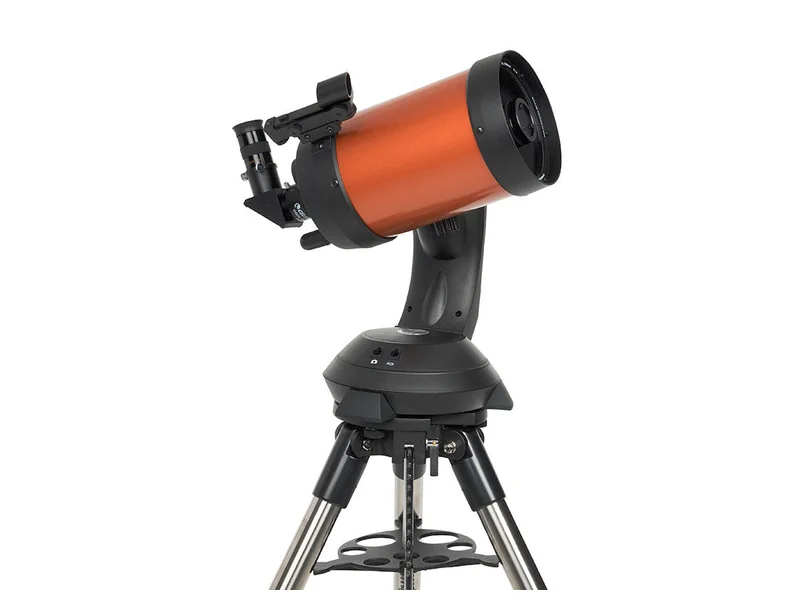
125mm aperture and a 1250mm focal length in a tube 33cm long. The scope and mount weigh 8kg, the tripod 4.5kg, so it goes in and out of a flat without fuss.
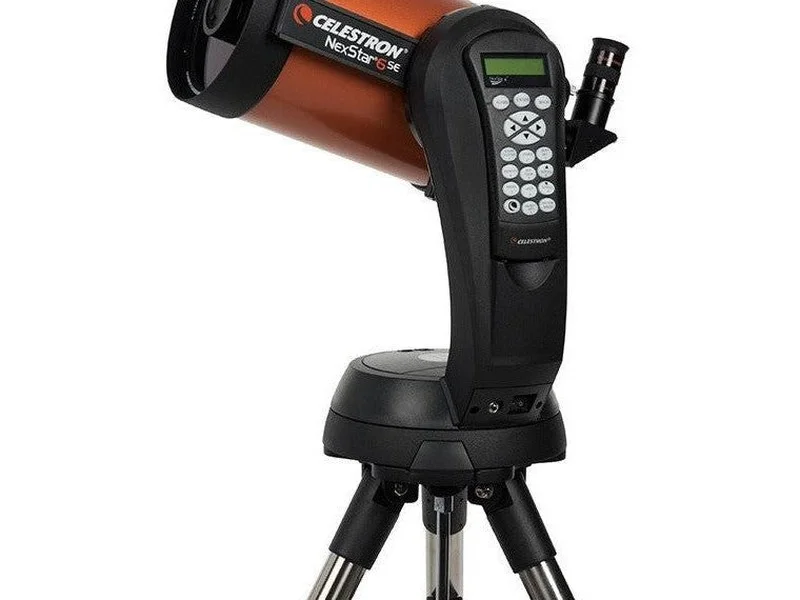
150mm aperture, 1500mm focal length, about 14kg all in. The sweet spot of the range: enough light for globular clusters, enough focal length for Saturn's Cassini Division.
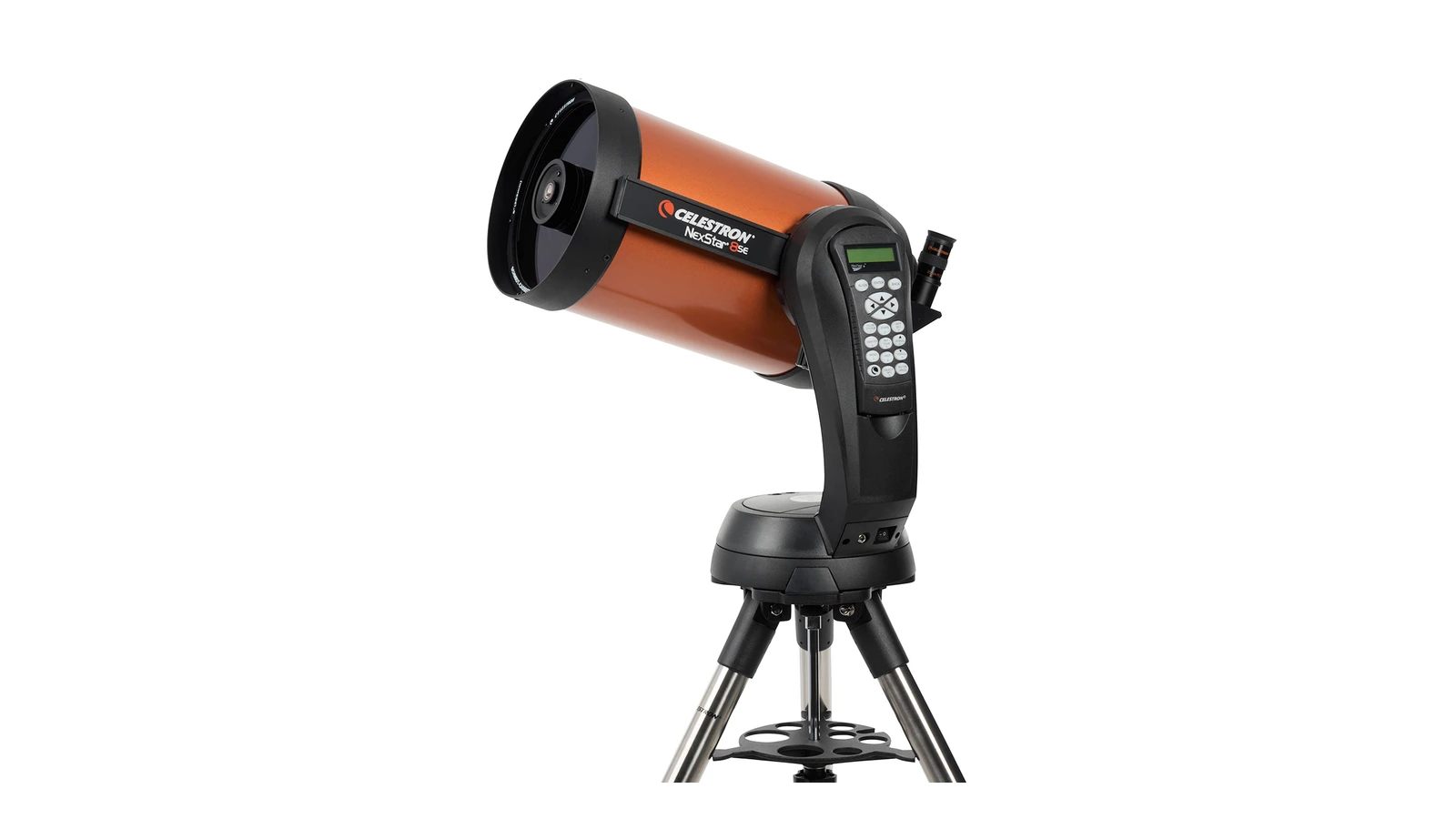
203mm aperture and 2032mm of focal length in a 43cm tube. Gathers 1.8 times the light of the 6SE and is the planetary imaging favourite. The mount is at its limit with it.
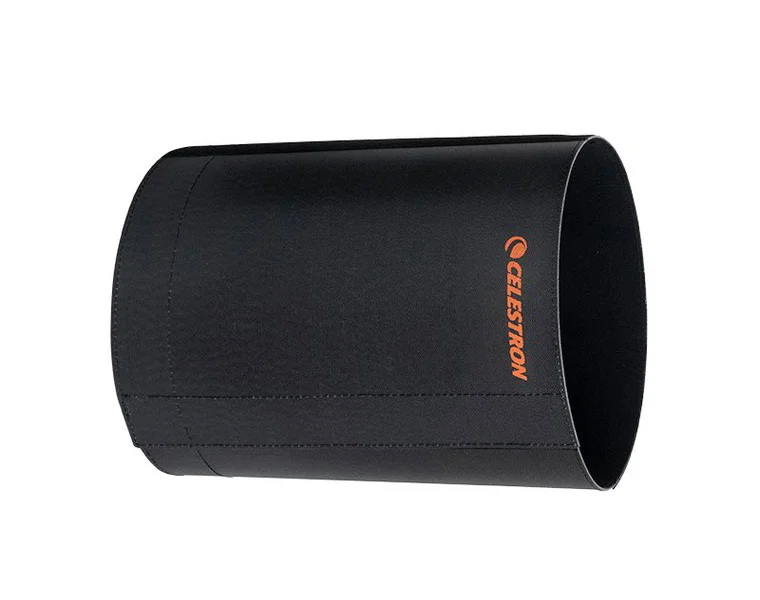
Celestron Dew Shield for C6/C8
The corrector plate at the front of a Schmidt-Cassegrain dews over in minutes on a UK night. A dew shield is the first accessory, not an optional one.
Affiliate links: you pay the same price, we earn a small commission that helps keep WatchTheStars free.
Celestron StarSense Explorer DX 130AZ: phone-guided finding without motors
The StarSense Explorer DX 130AZ answers the beginner's real problem, which is not seeing but finding. The telescope itself is a 130mm f/5 parabolic Newtonian with a 650mm focal length, the same optical recipe as the Sky-Watcher Heritage 130P, on a steel tripod with slow-motion controls. The clever part is the phone dock. The app looks at the sky through the phone's camera via a small mirror, matches the star pattern to its map, and shows an arrow on the screen. Push the telescope until the arrow becomes a bullseye and the target is in the eyepiece. There are no motors, so there is no tracking and no battery to run flat; nudge the slow-motion knob every minute or so at high power.
The catch is the phone. Celestron keeps a compatibility list, and older or budget phones with weak cameras struggle to plate-solve from a light-polluted garden. Check your model before you buy. If it is compatible, this is the quickest route from knowing nothing to finding the Andromeda Galaxy alone, which is why it leads the teenage picks in our telescopes for children guide. If it is not, the Heritage 150P at £249 gives more aperture and our stargazing for beginners guide teaches the star-hopping instead.
StarSense Explorer: your phone finds the target
Manual telescope, computer-assisted pointing
The StarSense Explorer app looks through your phone's camera at the sky, works out exactly where the telescope is pointing, and draws arrows to the next target. You push the telescope; the phone does the navigation.
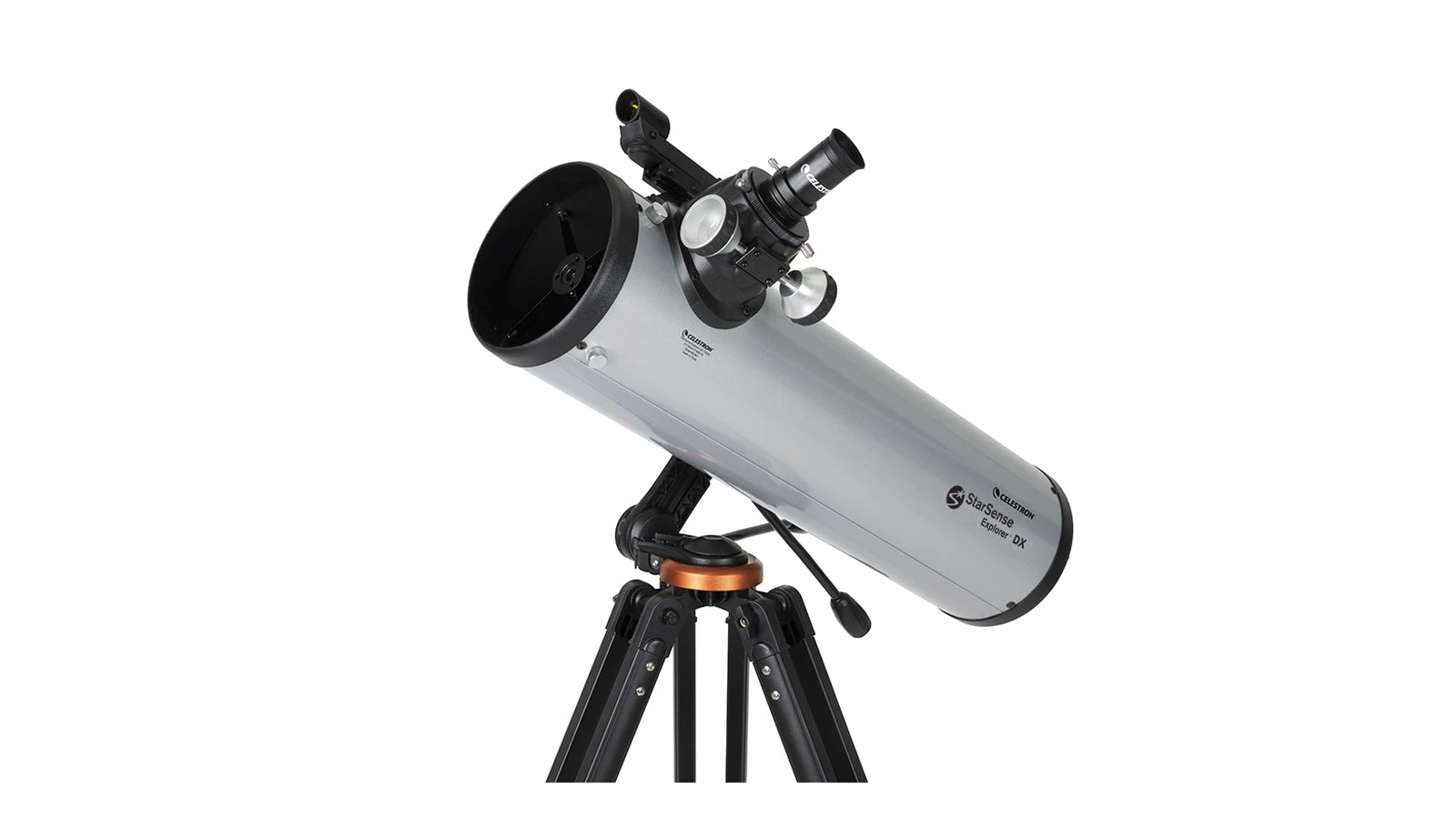
Celestron StarSense Explorer DX 130AZ
A 130mm f/5 parabolic Newtonian, the same optical recipe as the Heritage 130P, on a steel-tripod alt-azimuth mount with slow-motion controls. Check your phone is on Celestron's compatibility list first.
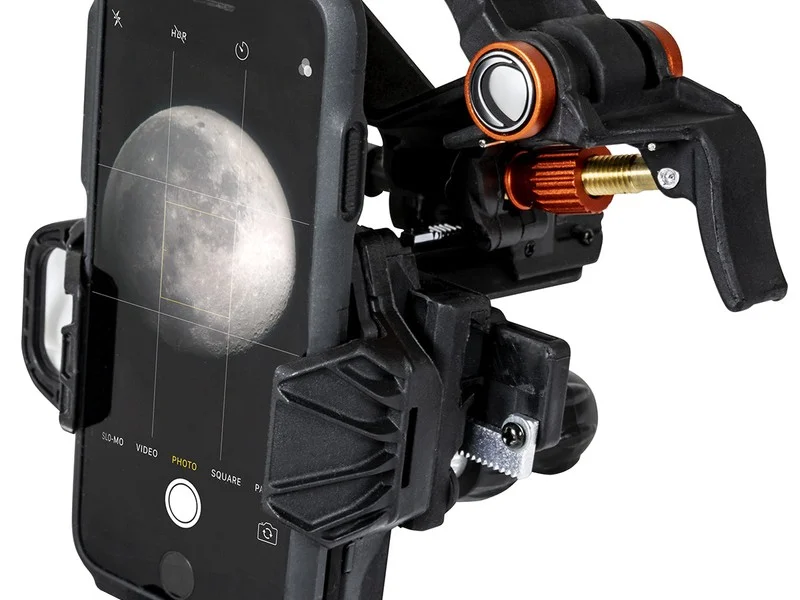
Celestron NexYZ Smartphone Adapter
A three-axis clamp that holds any phone over the eyepiece. The fastest way to a photograph of the Moon's craters through any of the telescopes on this page.
Telescopes for children and teenagers
Honest, research-based recommendations for every budget.
Browse all →Affiliate links: you pay the same price, we earn a small commission that helps keep WatchTheStars free.
Celestron SkyMaster binoculars: 7x50, 15x70 and 20x80
SkyMaster binoculars are the reason Celestron appears in so many beginner kit lists, because big-aperture binoculars are the cheapest way to see the Milky Way, comets and the Andromeda Galaxy properly. The SkyMaster Pro ED 7x50 at £189 is the hand-held pair: a 7.1-degree field and a 7.1mm exit pupil pour light into a dark-adapted eye. The SkyMaster Pro 15x70 at £229 gathers nearly twice the light of a 50mm pair and is the classic galaxy and comet binocular, but at 1.5kg it needs a tripod and an adapter. The SkyMaster Pro 20x80 at £305 is a pair of small refractors: globular clusters start to look granular and the Orion Nebula shows its wings, and a solid tripod is part of the price. Our guide to the best binoculars for stargazing compares them with the Opticron and Helios pairs we review, and binocular astronomy lists what to look at first.
SkyMaster binoculars: 7x50 to 20x80
Big aperture binoculars for the Milky Way and comets
SkyMaster is Celestron's astronomy binocular range. The 7x50 is hand-held; the 15x70 and 20x80 are small telescopes with two eyepieces and want a tripod.
Celestron SkyMaster Pro ED 7×50
A 7.1-degree field and a 7.1mm exit pupil for sweeping the Milky Way from a dark site. ED glass keeps bright stars clean. The pair to keep by the back door.
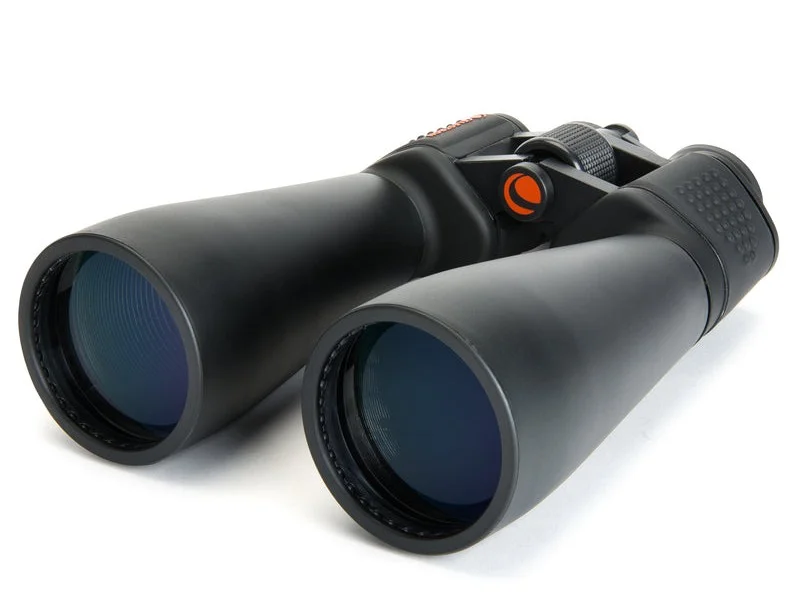
70mm lenses gather nearly twice the light of a 50mm pair. The Andromeda Galaxy, the Double Cluster and Jupiter's moons are easy. At 1.5kg, a tripod is not optional.
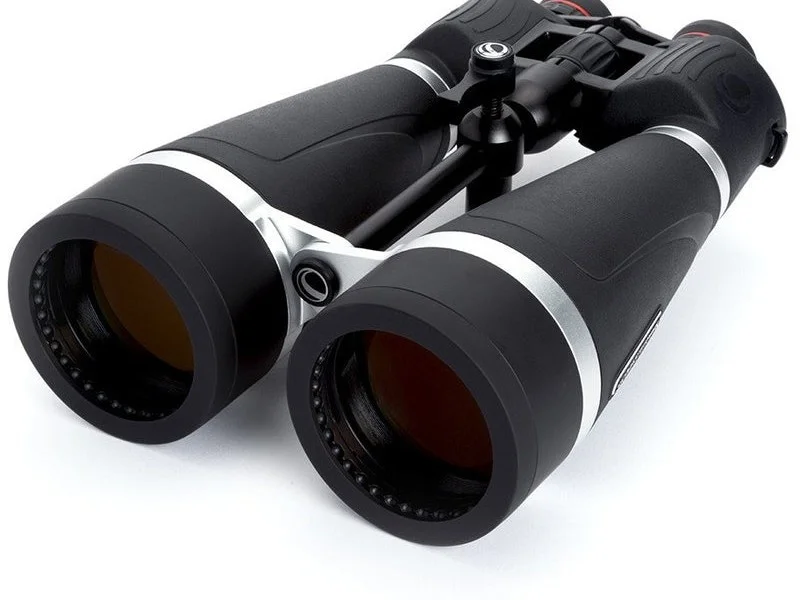
Celestron SkyMaster Pro 20x80
80mm lenses and 20x magnification turn globular clusters into granular balls and show the Orion Nebula's wings. 2.3kg, so budget for a solid tripod and mount.
Best binoculars for stargazing
Honest, research-based recommendations for every budget.
Browse all →Affiliate links: you pay the same price, we earn a small commission that helps keep WatchTheStars free.
Where to buy Celestron telescopes in the UK
Buy Celestron telescopes from a UK astronomy specialist with a UK warranty. We link to First Light Optics in Devon, which holds UK stock of the NexStar SE range, the StarSense Explorers and the SkyMaster binoculars, sells the dew shields, power tanks and adapters that go with them, and gives a 30-day return window. Celestron's official UK distributor is David Hinds Ltd, and warranty claims on a telescope bought from a UK dealer go through that route; a grey import from a marketplace seller usually leaves you dealing with a courier and a US warranty. NexStar prices track the exchange rate, so the cards on this page read the current figure from our product data.
Before spending more than £900 on a GoTo telescope, compare the alternatives: the Sky-Watcher Skymax 127 bundle at £547 is a GoTo Maksutov for planets at half the price of a 6SE, and the Seestar S50 vs Dwarf 3 comparison covers smart telescopes that photograph nebulae with no eyepiece at all. Our what you can see in the sky tonight page shows what any of them will find from your postcode this evening.
How we reviewed this
This is a research-based review rather than a laboratory test. The facts on this page come from the manufacturer's specifications, the First Light Optics listing and its customer reviews, and the long-running owner threads on Stargazers Lounge and Cloudy Nights, checked against what the same kit shows from a typical UK garden. We have not necessarily used every item ourselves; where we have, the page says so. We receive no free equipment, and the retailer links pay a small commission that never changes the price you pay or the verdict we give.
Prices are read from our product data, last checked against First Light Optics on 2 November 2026. Page last updated 6 November 2026. Own this kit and see it differently? Email [email protected] and we will update the page.